Wednesday, February 26, 2020

You Get Revolution When...

The Z-man uses a software metaphor to explain revolution. A business creates a software system to implement its business processes, but then needs to modify it. At some point the system becomes too expensive to modify, so the business throws the old system out and buys or develops a new one. So it is in politics:
When the humans can no longer change the system or work around it efficiently, the users of the system start to question the system. 
Thus 2016 and Trump and 2020 and Bernie:
The first round of efforts to modify the existing system started in 2016 with the election of Trump. We’re seeing a second round now with the apparent nomination of Bernie Sanders as his challenger. Trump was always a reformer who believed in the fundamental integrity of the system. Sanders is a revolutionary who promises to first remove the legacy system. 
Sorry. Don't agree. I think that Bernie is a last ditch effort to pedal-to-the-metal the welfare state, to preserve the legacy system. If Medicare is good, Medicare for All is better. If subsidized college is good, then free college is better. Bernie is saying: let's just pour more money into the legacy system. It's worked all these years; why change now?

What Bernie is doing is exposing the lie at the heart of the welfare-state project. It was not about what is good for America and Americans but what it takes to win elections with free stuff.

As you can see from the chart, US government spending as a percent of the economy has gone about as far as it can go.
So, really, when Bernie is proposing to double down on everything from Medicare to the Green New Deal, he is really telling us the the game is over. Because the net effect of politics since 1980 is steady as she goes.

Now I believe what is happening is that Americans are being offered two futures, by two competing upper classes. The old future, represented by the Democratic Party and the educated gentry is the old game of the Gentry combining with the lower-class Clients to loot the Commoners. Loot in return for votes. The new future, represented by Trump, is for the Commoners to rebel against the old system and demand that their Commoner concerns and aspirations be addressed. Something that the old Republican Party was failing to do.

But, the question is, can the Commoners possibly win this game, when you consider that the whole educated Gentry would get totally screwed if politics in the US were reoriented towards the needs of the Commoners? No doubt the Gentry would fight to the last Client in order to keep their privileges and authority and feed their ambitions to be the wise rulers teaching the deplorables their needed daily lesson.

But then you look at the chart above and see that government spending has gone about as furr as it can go. Are the American people -- those suburban moms -- really going to vote for a massive increase in government spending? Probably not, unless you can stampede them into believing that the planet is about to die.

See my analysis of politics so far is that the creative class, the educated Gentry, has been running for the last century on the idea that, oh, we are the guys that care about the helpless victims, the workers, the women, the blacks, the immigrants, the homeless.

That line was gold when the vast majority of Americans were indeed workers struggling up through the industrial revolution. And, in the post-WWII world, the program adapted to the workers as they became suburban home-owners.

But since the Civil Rights revolution the gentry game has been to give free stuff to minorities -- and now immigrants -- out of the hide of the white working class, which is now really the Commoner class.

Back in the day the Republican Party was a Gentry party of the educated and the fairly well-to-do that was arguing for moderation in the expansion of government. It accepted the premise of benefits for the workers, but not so fast that it wrecked the economy.

But Trump has reinvented the Republican Party into a Commoner party that is saying: why should we Commoners pay for you Gentry to bribe your Client voters with our lives and our money?

So US politics has been transformed into Commoners-stick-together against the century-old coalition of educated Gentry and Clients.

I'd say the situation is that the Democrats are beside themselves; they really do not have a clue what to do next. Because all of them are apparatchiks of the old order, where you offered a little bit more free stuff to the Clients, and that was enough to get you over the finish line, most of the time. And don't forget the Irving Kristol rule that you must deal in the middle class if you want to help the poor.

Notice something? The Dems have stopped dealing in the middle class. Because Medicare for All doesn't offer anything to the middle class; instead it takes away their health insurance for... Yes, for what exactly?

But why? Why would the Dems do this?

Well, I think it is because in any ruling class, or any corporate hierarchy, the guys that understood what they are doing are the founders -- of the state or of the corporation. The chaps that come along later and step into the slots created by the founders know how to check the boxes and how to recite the anthems, but they don't know why. And so when they turn the dials and press the buttons and nothing happens, they really don't know what to do next.

So Bernie is punching his buttons, and Joe is punching his buttons, and the others are punching various buttons they learned from the Elders. And nothing is working.

What they need is someone that knows what he is doing.

Everyone thinks that Trump is an idiot, and is fumbling and stumbling like an amateur and really does not know what he is doing. Or maybe he got lucky. Maybe.

But if I were a Dem I would tell everyone I know to cut the crap and assume that Trump does know what he is doing.

And I believe that the future of politics in the advanced countries is going to be Commoners-stick-together. Oh, and any of you Clients that want to join us Commoners, come on in; the water's fine.

Hey, it makes sense. Commoners are the majority. They oughta have a politics that responds to their needs.

Democracy, dontcha know.

Tuesday, February 25, 2020

Don't Panic! I Say Bring Bernie On!

It looks like all the usual suspects are panicking, as usual. And none more so than your regular Democratic operatives with bylines in the media. (Imagine! Wikipedia actually has that!)

OK. So I panicked for a moment. But then I thought, hey, we gotta fight this battle sooner or later. And really what better with a moonbat like Bernie Sanders going up against a street-fighter like Donald Trump?

I was to yoga this morning and what do you think? Jim the yoga teacher was all embarrassed about President Trump mispronouncing the name of the guy that brought yoga to the West. Well, I doubt if the 100,000 Indians at the cricket stadium -- what? there's a 100,000 seat cricket stadium? -- were too worried about that! Turning the tables, I think that there is something charming about furriners trying to pronounce Anglo-Saxon names. But at least they tried!

But notice what my liberal yoga pal did not talk about. Bernie. Oh, last week, before the Mike the Tyke debate rout and the Nevada rout, he was mumbling about Bloomberg or something.

Here are a few Good Things about a possible Bernie nomination:
  • It would teach all those nice suburban women a lesson. You girls ready for Bernie to take your health insurance away? Your SUV? Make higher education free so that your professional income can't compete against bright students with less money than you?
  • It would teach those twentysomething kids a lesson. Yeah kids! Americans don't like socialism. So why don't you grow up!
  • It would give America's gun owners a reason to show up and vote.
  • It would make it harder for nice moderate Democrats to win in nice moderate suburban districts. Remember how all those nice moderate candidates in 2018 were going to vote against Pelosi? Hey girls! Cat got your tongue?
  • It would permit eevil right-wing racist-sexist-homophobes like me to say forever after that, back in 2020, America was offered socialism and it voted it down (I hope) 60-40.
  • It would help the next Clinton to move to the center and declare on a stack of Bibles that he was a New Democrat and utterly rejected the divisive politics of Bernie.
  • It might even roll back the identity politics/intersectional priests and their ilk. For a while.
  • It might help President Trump clean out the Swamp in his second term.
  • It would make Florida red. Those Cuban-Americans aren't going to take Bernie lying down.
  • And so on.
Of course, socialism is personal for me. My dad was born and raised in Russia and escaped in 1918 at the age of 16 ten feet ahead of the Bolsheviks.

Shall we rehearse my anti-socialist notions, just for fun? First there are the Four Laws.
Socialism cannot work because it cannot compute prices (Mises).  
The administrative state cannot work because the Man in Washington does not have the bandwidth to run the economy (Hayek)  
Regulation does not work because “regulatory capture” (Stigler).  
Government programs cannot work because you can never reform them (Chantrill).
I think that is perfectly clear, don't you? And if you don't understand the first law, about prices, then you really don't get it. Prices, you see, are perhaps the most amazing cultural invention of humans ever. Prices enable us -- even the poorest -- to broadcast to the world what we are willing to exchange in the moment to moment dance of social cooperation, and for what value in exchange. It is what enables the unfathomable complexity of the market economy to function at all. The reason that socialism fails every time it is tried is because, under socialism, the consumers don't get a chance of feedback, to signal to the producers what they want -- or what they can be persuaded to want -- and what they are willing to pay.

Do you think that is enough? No. I think we need to mention the Great Reaction, the mad reactionary enthusiasm among lefties for the old days.
Socialism is a return to slavery;  
the welfare state is a return to feudalism;  
identity politics is neo-tribalism; 
reparations is neo-vengeance;  
activism is part medieval knight-errantry, part pro-regime street-thuggery, and part activisme, or gentry kids putting on a play;  
helpless victims are a return to sacrifice,  
social justice is good old loot and plunder.
 I'm sure the list isn't really exhaustive. But I'm working on it.

It all comes down to this, my US Politics in Four Lessons:
The American People are the best people in the world. 
The USA is the best country in the world. 
When you lose a normal change election you concede with a good grace. 
Anyone that accuses someone of being a racist is a monster.
Anyway. I am sure that Brad Parscale and the boys are busy working on the framework of a campaign against Bernie. 

And I am sure that President Trump is up to the challenge.

In face, think about it. What GOP nominee of the last 50 years is better adapted to run a campaign against a socialist and win? OK. Maybe Ronald Reagan.

Monday, February 24, 2020

Suppose We are Approaching the End of the Age of Politics

Here's what I think is interesting:
  • That about 250 years ago slavery became scandalous. Then we had the two biggest slave states in history. What was that all about?
  • That about 150 years ago war became pointless. Then we had the two biggest wars in history. What was that all about?
  • That about 250 years ago educated gentry decided that government power could and should be limited. Now we have the biggest governments ever that supervise endless details of people's lives. What's that all about?
I think that, following Crane Brinton in The Anatomy of Revolution, the sign that an age is ending is a frantic effort to keep it going, no matter what. That is, when you need a Reign of Terror to keep your movement going then your movement has a problem.

Let's recall slavery. We've all been carefully taught to hate and to fear slavery. But the fact is that 1,000 years ago it was ubiquitous. Viking society was divided into earls, peasants, and "thralls." Thralls were slaves. And the Vikings had a grand old time trading in slaves, from Dublin to the Volga River. At that time in England, according to Danziger and Lacey in The Year 1000, you, as a serf, could make yourself into a slave -- and the three squares that came with it -- by kneeling before your lord and placing your hands within his. And, if you want to know, the Venetians and Genoese did a grand trade in shipping Circassian beauties to the harems of the Middle East. And, I believe, the Circassian beauties were often sold by their families to the slave traders. Then, you may say, a curious thing happened. Slavery started to pay, as Venetian capitalists started slave sugar plantations on Cyprus. And then slave sugar spread west to the Atlantic, and then South America, and then, in 1640, the Brits got into the sugar slave game on Barbados. A grand old time was had by all except the slaves for about a century until, with the rise of evangelical Christianity and William Wilberforce, plantation slavery became a scandal. And we the US had the granddaddy of all civil wars over slavery. And then socialism inspired the two biggest slave states in history. You know who they were.

Today, of course, everyone hates slavery with a passion. Only, some people say that we are enslaved to our worker-bee corporate jobs, and work harder than any humans in history. What's that all about?

Let's think about war. Let's admit it: war was ubiquitous since whenever, whether it was hunter-gatherers contesting territory, or marcher lords patrolling the borders of feudal agricultural empires, or the Romans marching their legionaries all over the Mediterranean area, or the Frenchies and the Swedes marching all over the German lands in the 17th century. The trade of high-status males was war. And everyone down to male serfs was likely to get involved in the lord's nice little wars. Then, of course, the northwest Europeans conquered the world, starting in 1492. Europeans completely took over North America in flat-out conquest. And dominated the Central and South Americas without actually killing off the inhabitants. But then a funny thing happened. The Brits went to India and didn't really conquer it. They just wanted to trade, and keep the native princes from their traditional loot and plunder. And when it came to China, the westerners couldn't or didn't want to get anything more than a foothold in China and demand the right to have treaty ports where they could trade with the Chinese interior. Then we had Napoleon wrecking French primacy in Europe with his abortive conquest of Russia. But Bismarck cleverly united Germany with three finely sewn wars against Denmark, Austria and France. Then we had the reign of the idiots and World War I and II. What were they thinking?

I don't think we have really begun to process what has happened to the war culture over the last two centuries. Except that war really is not the cosy thing it used to be back in the day when the Franks did a nice bit of loot and plunder every year beyond the eastern borders of the Frankish empire.

And now politics. Politics used to be a natural hierarchical thing, with the king the lord of his lands, and everybody in their place beneath him. The king was mainly concerned with keeping his barons in check, and the barons mainly concerned with keeping their yeomen and serfs in their place. The fact is that political power had a limited reach because it lacked the technology to extend its power. But then, during the second millennium, an idea began to grow about limiting political power. First the barons pushed back against the king in Magna Carta. Then came all the theories of politics from chaps like Montesquieu proposing a division of powers between various political sectors that got instantiated in the US Constitution. What was that all about? And then we get what I call the Great Reaction of the last 160 years in which rich-kid sons of bnourgeois businessmen and merchants developed a theory of totalitarian unification of all human sectors: religion, politics, and economics, under a single leader, in which all life was militarized into a quasi-military hierarchy under a Great Leader. We have, now, the idea of the great war leader extended into all areas of life, so that administrative and hierarchical power from the top is concerned in all areas of life, political, economic, and religious/cultural.

I have a whole jumble of ideas about this, but I have an overall notion that politics is past its sell-by date, that we don't really need a vast political-ideological structure, that the human future is something completely different. And I believe that the current frenzy in the educated gentry for political and ideological power is a sign of the end of the political era. See, I don't think we need powerful muscular political institutions. Modern people are remarkably pliable and cooperative; they don't need a blow in the solar plexus to teach them a lesson. They respond pretty well to the social and economic cues they get from the people they interact with in day-to-day life. It is a conceit in the educated gentry, in my view, to think that the power and wisdom of the educated gentry is needed to keep us all from falling into a dark place of hate and bigotry and exploitation and poverty.

They say that every human generation thinks it is living in the end times of irreversible decadence, and that strong action is needed to reverse the slide. Probably not.

What is probably true is that the world is heading towards a future that nobody has a clue about. And that, indeed is scary. But the chances are that our descendants with muddle through. Imagine that!

But meanwhile we have to get through the current mania in the Democratic Party -- symbolized by unreconstructed lefty Bernie Sanders -- to have comprehensive and mandatory administrative solutions for everything for all time. Which is merely to say that the mess that comprehensive and mandatory administrative solutions have created in our society is reaching the crisis point, and that comprehensive and mandatory solutions for everything have reached their sell-by date.

Friday, February 21, 2020

Suffering, Religion, History, and the Three Peoples

According to Nietzsche, the Eternal Recurrence is the end point of decadence, the decline from growth and optimism. When you start to fall away from the faith of the fathers, then you get to nihilism, where you don't believe in anything. Then you get to the Eternal Recurrence, where your life is a meaningless repeat, day after day: Groundhog Day.

But in The Myth of the Eternal Return, or, Cosmos and History Mircea Eliade tells a different story. For him, the Eternal Return is a way, invented by our ancestors, of dealing with the unbearable suffering of life by escaping from history, and it is characteristic of all primitive peoples, pre Axial Age.
[S]uffering proceeds from the magical action of an enemy, from the breaking a taboo, from entering a baneful zone, from the anger of a god -- and when all other hypotheses have proven insufficient -- from the will or the wroth of the Supreme Being. (p.97) The primitive... cannot conceive of an unprovoked suffering; it arises from a personal fault... or from his neighbor's malevolence... but there is always a fault at the bottom of it[.]
But, in addition, primitive man escapes from history, the whole miserable story of endless suffering, with the Eternal Return, the annual renewal of the world in New Year celebrations, which erase the past and starts the world anew with a celebration that both marks a return to the chaos before the Creation and celebrates a new creation in the New Year.

You can see that this attitude survives into the modern era in the belief systems of the People of the Subordinate Self or Yarvin's Clients. Our lower classes attribute their sufferings to the malevolence of employers and billionaires. Or Jews, according to taste. And our periodic elections provide a chance for a new beginning, a Time for a Change, or Hope and Change, endlessly recycling without end.

Notice how this approach conflicts with Nietzsche. According to him, the Eternal Recurrence is the end point of decadence and failure and meaninglessness: really dumb. According to Eliade, the Eternal Return is an attempt to erase the eternal sufferings of life and begin anew: pretty clever.

Now, according to Eliade, when we get to the Axial Age religions, the priests are now trying to deal with history instead of hiding from it. Well, almost.
[History] can be tolerated because it is known that, one day or another, it will cease. History is thus abolished, not through consciousness of living in an eternal present... nor by means of a periodically repeated ritual... [as with primitives;] it is abolished in the future.
But the point is that, at some point, all the sufferings, i.e., history, will end. Yay!

Now, in Eliade's account, the question of "sin" arises when, e.g., with the Children of Israel, the prophets start selling the idea that the misfortunes of the Israelites are a consequence of them losing their faith in God.
Through their terrifying visions the prophets but confirmed and amplified Yahweh's ineluctible chastisement upon His people who had not kept the faith.
Do you see what is going on here? All of a sudden "the priests" are demanding that people take responsibility for their actions. You fall off the wagon, pal, and disaster will ensue. In other words, the Israelites are now supposed to be People of the Responsible Self, responsible for their lives before God and not mere helpless thralls that go crawling to the sorcerer or sacrificing the firstborn to the Supreme Being when things go wrong.

Note that Nietzsche excoriates "the priests" for teaching us to hate ourselves. But on Eliade's version, the priests are merely asking us to take responsibility for our lives, that our suffering is not the result of "the magical action of an enemy" but our own faults and sins. Got it, Fritzi?

OK. Whatabout our pals the People of the Creative Self? Where do they get off in this battle of the intellectual giants. Perfectly simple.

Nietzsche is telling us that we need to be free spirits, strong, growing, fearless. Willing to take the rough with the smooth, indeed actually seeking out challenge and difficulty. He is saying that we should stop whining about suffering, and trying to hide from history. Be a Man. That is what Nietzsche is saying.

Now it may be that the Nietzschean ideal is not just Übermensch, over-man, but beyond-man, that it challenges us to be something that is really beyond the capabilities of humans. That we cannot forget our sufferings and our fears, and need the comforts of the Eternal Return of the primitives or the Eternal Rest of eternity after history has ended.

And you may say that the collapse of Nietzsche into madness in 1890 proves this. Nietzsche, despite all his bold writing, could not really deal with the ideal he had conjured up. He set up his ideal of the man that lives without the comforts of home and the promise of paradise, but in the end couldn't live up to his ideal.

And you may say that our own overlords, the People of the Creative Self and Yarvin's Gentry, are jolly good at thinking up rules and standards for us Normals to live up to. But when it comes to themselves, the law doesn't apply to them. Any backtalk from the deplorables is rejected as racist-sexist-homophobic hate.

All true. But I think that it just shows that the Creative Turn is a lot more difficult and challenging than we first thought, back in the day when we special people decided that God is Dead.

Thursday, February 20, 2020

Government is Force. Part 742

It's just a minor piece from Steven Greenhut in California, "Taking Property for Fun and Profit," about high property prices in California and the resort to government to Do Something about it.

That is to say, they propose to solve the problem with Force. Of course they do, because Government Is Force.

You don't like the way that the world has treated you? If you are the Vikings you get in your longships and head out for a bit of loot and plunder. If you are a worker in the late 19th century hammered by the Long Depression of the 1870s and 1880s, you strike your employer to protest wage cuts.

If you are a homeless mom in Oakland, why, you take over a vacant house and the local activists celebrate you.
As one of these Oakland moms said, “Housing is a human right. I pay bills there. I pay water, PG&E, internet. We live there. We want to purchase the home; it needs to belong back in the hands of the community. It was stolen through the foreclosure crisis.”
Or this in Los Angeles.
The Los Angeles city council might use the power of eminent domain to seize a 124-unit apartment building called Hillside Villa in Chinatown.
See, back in 1986 when the owner built the apartments, part of the deal with the government was to provide some below-market-rate apartments. Now, 30 years later, the owner wants the rent the apartments out at market rates, but "Councilman Gil Cedillo’s plan would have the city take the apartment building to maintain the lower rents."

The point is that all this government force doesn't solve the housing affordability crisis. As Greenhut writes:
The bigger issue, however, is that Los Angeles and other California cities have screwed up their housing markets through decades of excess regulation, slow-growth rules, rent controls, and other policies that depress housing construction and drive up the price of the housing that everyone says they want.
Yeah. And where are the wise heads in the media telling us everyday that regulation, slow-growth, environmental rules, rent control are the best way in the world to destroy the housing stock in a city and make it affordable only for the very rich?

How can it be that a presidential candidate like Bernie Sanders that wants government to take over everything from health care to student loan forgiveness is not laughed out of court?

OK, so Bernie's supporters feature kids from educated families that have had everything handed to them and don't see why it shouldn't continue.

And every kid today seems to be taught the holy art of activism and peaceful protest and the fun of making protest signs and banners.

But suppose I sent out to the local yard-sign company and axed 'em to make me up a sign like this to put in my front yard?

Or this one?

Do you think that I would get my car keyed by some irate Bernie Bro? Or similar Subaru type with a COEXIST bumper-sticker?

You tell me.

Now I think, in fact, that we humans are in a confusing transition era, between the necessity of force to protect our food-growing land in the old days and the necessity, today, of cooperating with everyone in the world to make and sell things.

And I think that our lefties are glorious reactionaries, overflowing with nostalgia for the good old days when every man word his salt was a warrior. Or a revolutionary.

But I say that today's activists are reactionaries, imagining themselves as revolutionaries. Bu they are really modern Don Quixotes, for
activism is part medieval knight-errantry, part pro-regime street-thuggery, and part activisme, or gentry kids putting on a play.
"Activisme" is French for "activism." If you were wondering.

But it still comes down to "Government is Force." And, I think, force is on its way out. Like slavery.

But you knew that.

Wednesday, February 19, 2020

Deficits: Where Does It End?

The deficit hawks are always there, worrying about deficits as far as the eye can see. And they are right. Sooner or later the bill will come due.

Here's a piece featuring Fed Chairman Jerome Powell worrying about how the Fed can fight the next recession when interest rates are already at all time lows. Well, it turns out that he'll just print money, like the last time. But whatabout the budget?
“Putting the federal budget on a sustainable path when the economy is strong would help ensure that policy makers have the space to use fiscal policy to assist in stabilizing the economy during a downturn,” Powell told the House Financial Services Committee.
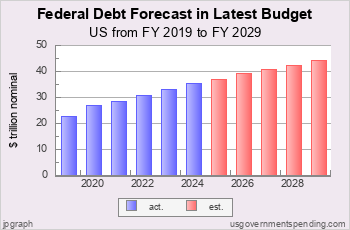
Yes, Yes. Of course. Let's Do Something about the deficit and solve all our problems. We could, you know. Because we did it before. See my "Federal Debt Analysis" and this chart.
See what's going on? In World War II our politicians shot the federal debt up to 120 percent of GDP to fight the Nazis and the Japs. Then, for the next 35 years until 1980 they brought the federal debt down to about 30 percent of GDP.

Look what happened then. Our politicians, led by Ronald Reagan, pushed the federal debt up to 60 percent of GDP by the end of the 1990-91 recession.

Then we had the mother of all financial crashes, 1929 excepted, in 2008. And our politicians ran the federal debt up to 100 percent of GDP.

So you tell me. What is different about now compared to the 35 years after WWII?

Well, all I suggest is that, back in the day, the ruling class all agreed -- nod, nod, wink, wink -- to haul the debt down from the wartime peak at 120 percent of GDP. No talking out of school, chaps, we just do it.

But then the Dems did the Great Society in the 1960s and failed to curb it when the data showed it was a failure, as documented by Charles Murray in Losing Ground.

So chaps like Ronald Reagan said: OK, if you Dems aren't going to curb your failed programs we aren't going to play green-eyeshade accountants over taxes. We are just going to cut tax rates and let her roll. Hey, the spending programs all benefit your Dem voters anyway; it's your job to look after them.

And that has been the rule ever since. When Dems get in they up taxes a bit and spending a lot. When GOPs get in they cut taxes a chunk and increase spending a bit.

President Trump has done nothing except continue that policy. Only now the federal debt, instead of 30 percent of GDP in 1980, is over 100 percent of GDP.

So, sooner or later, something will have to give. But what?
OK. So what gives? Well, roughly speaking 25 percent of the federal budget is defense, 25 percent is health care as in Medicare and Medicaid, 25 percent is Pensions including Social Security, and the rest is up for grabs, except for interest on the debt which right now is at about 10 percent of the federal budget.

Right now, nobody is willing to cry Uncle. Old men won't let anyone touch their Social Security. Old women and daughters of old women won't let anyone touch their Medicare. Defense? Maybe. Welfare? Maybe. The "Remainder" that includes interest on the debt? Well, that's the money that the educated Gentry feeds on in grants and deep-state sinecures.

So you can see that nothing will happen until the pips begin to squeak.

And you can be sure that whatever happens the old geezers like me will demand to keep the benefits we paid for and the deep state will demand its grants and sinecures.

So the guy that will get hurt will be that fellow behind the tree.

The only optimistic thought is that the ruling class will want to solve the problem without a total economic meltdown because if there is a true economic meltdown then their power as a ruling class might come under revolutionary challenge.

And we wouldn't want that would we?

But, there is a problem. Look at Nancy Pelosi. I look at Nancy Pelosi and I don't see a full deck of cards. I see someone blundering around in a strange land that Daddy never told her about.

And that could be a problem.

Tuesday, February 18, 2020

Scott Alexander's Two Tribe System vs. My Three Peoples

I just picked up a link to Scott Alexander's Slate Star Codex piece "I Can Tolerate Anything Except the Outgroup." It models the US as Blue Tribe vs. Red Tribe on the current political color model inaugurated in 2000 that makes liberals blue and conservatives red. Rather than lefties red on account of the Red Flag of communism.
The Red Tribe is most classically typified by conservative political beliefs, strong evangelical religious beliefs, creationism, opposing gay marriage, owning guns, eating steak, drinking Coca-Cola, driving SUVs, watching lots of TV, enjoying American football, getting conspicuously upset about terrorists and commies, marrying early, divorcing early, shouting “USA IS NUMBER ONE!!!”, and listening to country music. 
The Blue Tribe is most classically typified by liberal political beliefs, vague agnosticism, supporting gay rights, thinking guns are barbaric, eating arugula, drinking fancy bottled water, driving Priuses, reading lots of books, being highly educated, mocking American football, feeling vaguely like they should like soccer but never really being able to get into it, getting conspicuously upset about sexists and bigots, marrying later, constantly pointing out how much more civilized European countries are than America, and listening to “everything except country”.
This was written back in 2014. Before Trump.

Notice what is missing? The Victims Tribe. Actually, Alexander does get to them, eventually, when he says that
Research suggests Blue Tribe / Red Tribe prejudice to be much stronger than better-known types of prejudice like racism. Once the Blue Tribe was able to enlist the blacks and gays and Muslims in their ranks, they became allies of convenience who deserve to be rehabilitated with mildly condescending paeans to their virtue.  
Oh. But do you notice something? Blacks and gays and Muslims are not accorded the dignity of identity, or of a tribe of their own. They are just to be enlisted into the Blue Tribe. In other words, Alexander confirms my doctrine of the Victims as "Little Darlings" that the Blue Tribe dotes on. The Little Darlings are wonderful and pure and perfect until they are no longer useful politically, like the white working class.

But, of course, Scott Alexander goes on for 8,500 words without really describing the point of it all.

The point is that the Blue Tribe is the Gentry, the creatures of the ruling class, and they are ambitious. Yarvin calls their ambition thymos, from the Greek, meaning in Plato: Spiritedness (ego, glory, honor). For Yarvin, "thymos is somewhere between ambition, honor, and vanity."

And the Red Tribe is the Commoners, ordinary people that just obey the law, go to work, and follow the rules.

I am referring here to Curtis Yarvin's "Clear Pill" notion of a three-layer society, of Gentry, Commoners and Clients, where
The gentry are urbanites, cultivated and ambitious; the commoners are suburbanites, educated and independent; the clients are Marx’s proletariat and lumpenproletariat, uneducated and/or dependent.
Yarvin's three layers correspond pretty nearly to my reductive Three Peoples theory, in which my People of the Creative Self are his Gentry, my People of the Responsible Self are his Commoners, and my People of the Subordinate Self are his Clients.

Now it seems to me pretty clear that the thymos of the Blue Tribe or Gentry depends upon the opportunity for glorious deeds. Back in the day, these deeds were military, warrior deeds. These days the warriors are become social justice warriors, bending the arc of history towards justice and bravely whacking the Red Tribe, the Commoners, into surly and demoralized obedience for the notorious thought crimes of racism-sexism-homophobia. And the Blue Tribe, the Gentry, are held together by their hatred of ordinary Commoners. Not really accorded agency are the Clients of the ruling class, blacks and Hispanics and Muslims and immigrants, who are useful as soldiers in the political wars.

The whole of Scott Alexander's piece describes in excruciating detail how the Blue Tribe hatred of the Red Tribe works. And, boy, it works beautifully. But what it does not point out is the point of it all, indeed the point of all tribalism.

The point of tribalism is to unite the group to fight against the foe. Which is usually next door. And it performs a real function, which is to protect the tribe's food-growing land and the very food that the tribe eats.

Obviously this tribal instinct can be abused. For instance, it can be turned inward so that the tribe finds itself split into two factions that experience each other as the enemy rather than the tribe next door. Maybe the tribe will split in two and divide its tribal lands in two.

Or, as in the 20th century, the tribal instinct can be used to make the industrial nation state next door the enemy, when the nation state is no longer a semi-isolated group depending for survival on its food-growing land but on its ability to produce and sell its industrial and intellectual products. What, you might ask, is the point of Germany and France going to war in 1914? Or in 1939? Hitler had the idea in Mein Kampf that Germany needed food-growing land. Because of course it did.

The same argument can be made about the current culture war between the Blue Tribe and the Red Tribe, or the domination of the Commoners by the Gentry and their allies the Clients. If there is no external enemy then you naturally switch to an internal enemy.

If you are going to have politics you are going to have Us and Them. Because that is the whole point of politics, to stand forth as the savior of the tribe and protect the tribe from its enemies.

Now, given that humans naturally divide up into Us and Them, into Red Tribes and Blue Tribes, it would seem that wise men would seek to find a way to tamp down this natural divisiveness down to a dull roar.

Oh yeah. Limited government. Separation of powers. Creating a defense in depth against political ambition and rage. Oh, and above all, separating government, the sector of force, from religion, the sector of meaning.

Oh yeah. That's what all the political thinking of the eighteenth century was about: trying to avoid a repeat of the religious wars of the seventeenth century. By getting everyone to cool their jets, and trying to take religion out of politics.

But try telling your Blue Tribe friend that modern leftist politics is religion by any other name.

Hey, today's lefty liberals have almost convinced me of Marx's dictum that
The history of all hitherto existing society is the history of class struggles. 
Only it's not quite the way that Marx and Bernie and the Bernie Bros and the Blue Tribe of the Gentry think. It's not about heroic revolutionaries saving the proletarians from the savage power of the bourgeoisie. Not any more.

No, I'd say that today's class war is about saving the ordinary Commoner from the Gentry's need for meaning.

And that's what gives my life meaning. So to speak.