Wednesday, October 30, 2019

The Left's Dilemma: It Can't Undo Its Mistakes

How do we understand today's left? I stumbled into a piece about that yesterday that suggested that
contemporary Left-wing politics “is better understood as less of a political movement and more as a form of identity or enjoyable past time”. It has become more a “consumption activity” than a way to improve people’s lives[.]
Or, if you like,
Left-wing politics has become “a matter of shallow appearances, or fatuous self-righteousness… a politics in which the beautiful and wellborn tell the unwashed and the beaten-down and the funny-looking how they ought to behave”. 
But why, I thought to myself?

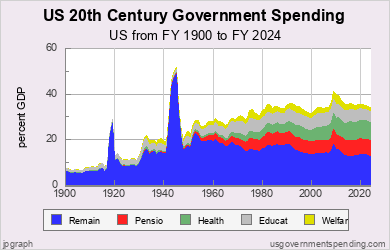
And so I came up with an answer. First, look at this chart of government spending in the US:
And look at this chart of public spending in the UK.
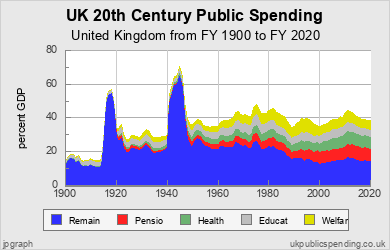
Notice something? Exactly. Spending on government programs ramped up in the first half of the 20th century, but for the last half century spending has been pretty steady, at about 35 percent of GDP in the US and 40 percent of GDP in the UK.

In other words, we probably aren't going to see any more increase in government spending in our two countries. Despite all the Sturm und Drang it seems that government spending has hit its natural limit. I don't pretend to know why, but it sure looks like some natural limit has been reached.

In other words, if you are a leftie, and presumably want to help the less fortunate, the oppressed and the marginalized, you are facing a bit of a problem. There doesn't seem to be any room for more spending on the less fortunate, the oppressed and the marginalized.

Let's look at the four great heads of modern government spending.

First of all there is government pensions, at 6.7 percent in the US and 7.8 percent in the UK. The problem is that a big chunk of that goes to the middle class, especially middle-class government workers. Don't think you are going to be able to take much money away from middle-class government workers and give it to the poor. The recent teacher strike in the City of Chicago, a city already in dire financial straits, should tell you all you need to know. You can't take monies away from the current beneficiaries, deserving or not. They will tear the place down.

What the left should have done, back in the day, was legislate a mandatory savings program for all workers through private sector financial institutions -- e.g. Fidelity and Vanguard -- and leak some monies out of something, somewhere, to take care of the poor. That way it wouldn't take 6-7 percent of GDP, but we would still have a national pension program that looked after itself. But it's too late for that, because if you try to mess with Social Security you will have the wrath of tens of millions of ordinary American retirees on your head.

Then there is government health care, at 7.8 percent in the US and 7.8 percent in the UK. In the UK it provides basic care for everyone, but anyone that is anyone has private insurance because the service at the NHS is pretty poor. In the US we have the fabulously expensive Medicare for seniors supplemented by Medicais for the poor. But what about the people just above the Medicaid threshold? That was the problem with Obamacare, trying to square the circle between Medicare, Medicaid, corporate health plans and individual health plans. If you want to take care of the people in between you practically have to destroy the existing system in order to save it. That's why President Obama had to lie about Obamacare, promising that "if you like your doctor you can keep your doctor" and predicting that the average person would save $2,500 a year in premiums. Not. So as soon as the next Democrat tries to square the circle again they will find huge opposition from people that don't want their existing arrangements messed with, in particular women on Medicare.

What the left should have done, back in the day, was legislate a mandatory health insurance plan, which tried to make health care into a Walmart for Health, and leak monies from somewhere to look after the poor. The idea would be to make sure that routine medical care was no more of an expense than the cost of maintaining a car, but that when you get to the big stuff, just like liability and collision insurance for cars, ordinary Americans don't get wiped out. And you'd have a mandatory program to get people to save for end-of-life medical expenses, something like life insurance. That way it wouldn't take 8 percent of GDP, but we would still have a national health insurance program and a senior health program that basically looked after itself. But it's too late for that, because if you try to mess with Medicare you will have the wrath of tens of millions of ordinary American retirees on your head.

Then there is government education, at 5.3 percent GDP in the US and 4.2 percent GDP in the UK. It seems to me that the current system works pretty well for the upper middle class, who seems to glide through and get to selective colleges. But whatabout the ordinary middle class that really just want to get decent skills for a decent job? And whatabout minority kids from families with little interest in literacy and numeracy? Whatabout kids that trustingly go to college and pile up student debt on some useless degree that doesn't get them a job? Just try reforming education: you run into a brick wall with the tenured college professors and the tenured and unionized K-12 teachers. And so the system is slowly degenerating into a system that does very little education but provides a lot of jobs for Democratic voters.

What the left should have done, back in the day, was legislate a comprehensive apprenticeship and training program mandating employers to provide jobs and education for teenagers starting, say, at age 12. That way the employers would be educating and training young people to qualify for the positions that the employer needed to fill right now, or expected to need to fill in the future. I'd say that employers have a much better idea of the kind of employee they need than government education bureaucrats. And younger kids? I'd recommend home-school, run by the neighborhood women, augmented by governemnt grants for areas with low literacy. But it's too late for that, because if you mess with the college professors and administrators and the union teachers you will be thrown out of office.

Finally, there is government welfare, at 2.1 percent of GDP in the US and 5.7 percent of GDP in the UK (wow, that different!). Obviously these programs have not been too good for the poor as they discourage marriage and discourage getting a job. Thus we have, as reported by Charles Murray in Coming Apart, that for whites only, at the bottom 35 percent the men don't work much and the women don't marry much. I'd say that's a problem, but if you were to make a significant change, by encouraging work and marriage, you would encounter a storm of protest from every lefty in the land and every bureaucrat servicing the poor and every recipient of welfare benefits. Who needs it?

What the left should have done, back in the day, was legislate mandatory membership in some mutual aid society of the kind that flourished in the 19th century. They were run by ordinary people and they naturally responded to the needs of the ordinary people they served. They were doing fine until the left legislated government welfare and put their nations through spine-rattling wars and Great Depresssions. But it's a bit late for that because all the old mutual-aid societies have withered on the vine in the last century, and if you ask a lefty they have no idea that the 19th century mutual-aid societies even existed!

Now, I get it. The purpose of government programs isn't really to provide working systems for pensions, health care, education, and welfare. The purpose of government programs is to win elections by promising loot.

But my feeling is that we have reached the limit of promising loot. That's why the level of government spending in both the US and UK has been pretty level for the past half century. You promise more loot to Group X and Group Y notices that they are going to have to pay for Group X's loot. Sorry Charlie.

So the net result is that we can't go forward and reform the welfare state because a lot of people would have their benefits reduced or at least endangered by any reform. And they will stop any attempt at reform.

So of course our lefty politics has degenerated into "a matter of shallow appearances, or fatuous self-righteousness… a politics in which the beautiful and wellborn tell the unwashed and the beaten-down and the funny-looking how they ought to behave." The lefties had their chance and they blew it; now they are reduced to posturing.

And now there is just about nothing we can do until the whole system comes crashing down.

Tuesday, October 29, 2019

Why the Jews Take the Cake on Nationalism

Here I was, sailing along unconcernedly as a seagull, when all of a sudden a Jewish acquaintance woke me up.

She alerted me to the fact that the modern Hebrew spoken in the nation of Israel is a made-up language. I had never thought of that before.

Modern Hebrew, says La Wik, was put together by a guy called Eliezer Ben‑Yehuda starting in about 1881 when he immigrated to Palestine. Ben-Yehuda was born in Russia and went to study at the Sorbonne in Paris in 1877 where he met a Jew from Palestine and managed to communicate using biblical Hebrew. La Wik:
It was this use of Hebrew in a spoken form that convinced him that the revival of Hebrew as the language of a nation was feasible.
So Ben-Yehuda went to work on Modern Hebrew, "using 8,000 words from the Bible and 20,000 words from rabbinical commentaries" and inventing other words. My Jewish acquaintance says he also updated the verbs and stuff.
Ben-Yehuda regarded Hebrew and Zionism as symbiotic: "The Hebrew language can live only if we revive the nation and return it to the fatherland," he wrote.
And then along came Theodor Herzl, of Pest, Hungary, who created Zionism the movement with his 1896 book, Der Judenstaat (The Jewish State). But Zionism must have been a thing by 1876, when George Eliot published her Daniel Deronda. So, Herzl's Zionism was mashed together with Ben-Yehuda's Modern Hebrew to create the cultural foundation of the national State of Israel, the national home of the Jews.

This confirms my theory of nationalism, that it is, along with all political notions, a fake tribalim to create a national myth around the notion of the Jews as a nation. So today in the state of Israel we have all the conditions that help create a viable nation state.

We have a common language. In most nations the national language was imposed on the rest of the nation by the chaps that created the nation. For instance, French is the language of the folks in the Île de France. Italian is the language of the people of Tuscany.

We have a common religion. It goes without saying that the more the people in a nation are united by a common religion, or common church, the better. But the people on the outside looking in, as Muslims in Israel or Catholics in a Protestant country, religion forms a basis for uniting against the nation.

We have a common "race" or ethnicity, or tribe. As I have said, all such identities are "fake." It is really an attempt to recreate the original tribe of the kindred, people related by blood, and imprint it on a larger grouping. Are the Jews of the Diaspora, the Ashkenazi Jews and the Sephardic Jews, members of a nation? They are if they believe it to be so. And it helps if they share the same religion and the same language.

We have a common history. Well, history is written by the victors, making up a sacred history to justify their political ascendancy. Or, if you like, history is the lie agreed upon. Every tribe needs its sacred myth; every dynasty needs to establish the divine heritage of its kings; every nation needs to show that it was favored by God.

We have a victorious war. Nothing unites humans, especially human men, as the brotherhood of warriors. And the state of Israel had to establish itself in war in 1948 and afterwards.

What is astonishing to me, after my realization of the made-up nature of Modern Hebrew, is the remarkable achievement of the Jews in making up the nation of Israel not in the traditional way of slow accumulation, by slow feudal transitions and petty conquests, accidents of palace politics, and assimilations of neighboring princedoms. We have the invention and the creation of the nation and the state of Israel out of whole cloth in the modern manner, by some guy writing a book and another guy inventing a language, and a modern publicity campaign inviting all Jews to come to Palestine. It is an amazing achievement. La Wik says Zionism was a response to antisemitism and also to the Jewish Enlightenment. But I'll bet that the real driving force was that the emergence of Nations out of the dynastic regimes of Europe inspired the Jews that were rising fast once Jews got to participate directly in the modern economies of Europe to say: Hey, this national idea is really cool. Why can't we Jews have our own nation?

Why not, indeed. And, I'd say that probably nobody but the Jews could have pulled it off.

The point is that it proves the immense power of nationalism as a way of uniting humans into a political community. The ingredients are language, religion, ethnic origin, and a war of liberation. All of these are unifying forces and the more the merrier.

The problem is, of course, that when some new political tendency arises in an existing nation it is going to want to unite people and divide people across different axes than the people of the current nation were originally unified. That is why our current ruling class wants to unify people through identity politics and through their supranational globalism. It's because they can't win, can't create a majority for their governing agenda of rule by the educated class, unless they knock over the current statue of America the Nation with another political idea. President Trump is countering this strategy of the educated ruling class with his Make America Great Again meme, which is a clear effort to unite Americans of all kinds around the American National Idea (whatever it is). He may succeed, or he may not.

Meanwhile, the Jews in Israel have really achieved the impossible, creating a nation out of whole cloth with its own language, own religion, own sacred history, and its own glorious victory.

It doesn't get any better than that.

Monday, October 28, 2019

Nietzsche in 900 Words -- If You Can Take It

There I was at the gym, reading my Nietzsche on a cardio machine that made it difficult to read because I couldn't use my regular cardio machine because I cannot stand listening to nearby women talking loudly to each other on the cardio machines.

And all of a sudden, Fritzi explained the whole procedure, in a couple of pages in The Will to Power. Of course, The Will to Power was not published in Nietzsche's lifetime; it is a collection of notes in his usual aphoristic style, so who knows what he really meant. But still. He explained his pitch:  on morality, decadence, nihilism, Eternal Recurrence, and Will to Power just like that. Slam, bam, thank you ma'am. It is all presented at the end of Book One: European Nihilism starting at Section 40.

For instance, I had not really got the point of his Eternal Recurrence thingy until now.

Let's start with Morality (Section 55):
It was morality that protected life against the despair and the leap into nothing, among men and classes who were violated and oppressed by men; for it is the experience of being powerless against men, not against nature, that generates the most desperate embitterment against existence.
But what happens when people start to lose their faith in morality?

Decadence (Section 40):
The concept of decadence.-- Waste, decay, elimination need not be condemned; they are necessary consequences of life, of the growth of life. The phenomenon of decadence is necessary as any increase and advance of life; one is in no position to abolish it.
In other words, when the old order -- particularly the old morality -- is collapsing, maybe because God is Dead, we get a period of decadence. Nothing to be ashamed of: Just life.

Which brings us to nihilism. Nietzsche does not champion nihilism. He just regards it as natural and physical when some religious belief or morality has collapsed. (Section 55)
Nihilism is a symptom that the underprivileged have no comfort left; that they destroy in order to be destroyed; that without morality they no longer have any reason to "resign themselves"[.]
And so we get to the Eternal Recurrence. In the collapse of morality into decadence and nihilism it seems
as if everything were in vain... [So] "Are not all 'values' lures that draw out the comedy without bringing it closer to a solution? 
Let us think this thought in its most terrible form: existence as it is, without meaning or aim, yet recurring inevitably without any finale of nothingness: "the eternal recurrence."
In other words, it is the nihilist, demoralized by the collapse of morality and the increase of decadence and decay, who collapses into nihilism and a philosophy of eternal despair.

Thus to the Will to Power (Section 55):
Who will prove to be the strongest in the course of this? The most moderate; those who do not demand extreme articles of faith; those who not only concede but love a fair amount of accidents and nonsense; those who can think of man with a considerable reduction of his value without becoming small and weak on that account: those richest in health who are equal to most misfortunes and therefore not so afraid of misfortunes -- human beings who are sure of their power and represent the attained strength of humanity with conscious pride.
How would such a human being even think of the eternal recurrence? 
Easy for you to say, Fritzi. Be not afraid of misfortunes.

The Will to Power is obviously a difficult concept for us post-Nazi humans. Because we think of the Will to Power as the Nuremberg rallies and SS stormtroopers and concentration camps. Of course, the worstest Will to Power of all was Lenin and Stalin and Mao who created societies of what the Jewish intellectual Georg Lukács approvingly called "totality." Yep, societies which were defined solely by political and military and ideological power. And which were, dialectically, incredibly weak.

Well, the truth is that Nietzsche's Übermensch is indeed a disturbing and unsafe chappie, for he is not afraid to burst all bounds. Bronze Age Mindset by Bronze Age Pervert is all about that. And one of Pervert's ideas is that the real man is a pirate, unafraid to sail around the world in tiny wooden sailing ships looking for trouble.
Crusaders like Cortes and Pizzarro, Fernando de Soto, Drake and Raleigh, Magellan and Balboa equal in daring, intelligence, magnitude of spirit, resourcefulness and achievement any of the great men of the Greeks and the Romans.
As the hero says in Pirates of Penzance:
It is a glorious thing
To be a pirate king.
In my reductive Three Peoples theory I say that the modern thing is to be a creative person, one of the People of the Creative Self. But, as Pervert says, "I don't promote for you the life of the scientist, or artist, or writer, because in our age these degenerate into hobbies and ways to pass the time, and there's no value in this." The true creative life is indeed the work of God, to create the world anew. But that means that the creative life is the life of a man, to be a creator, fighter, destroyer, a life indeed with no happy ending, as is required in all religions up to and including socialism.

I think that the quintessential Bronze Age man, or Übermensch, is Elon Musk: crazy, fearless, piratical, willing to take the government's money to make stupid electric cars on the one hand, and make rockets to go to Mars on the other. 

Friday, October 25, 2019

Not "Downscale" But Midscale: That's Today's Republican Party

Used to be that the Republican Party was an upscale party, writes Michael Barone. You could tell that by the way that the upscale media wrote.
Sixty years ago, when the Democratic Party was dominated by Southern whites and Northern factory workers, major newsmagazines and newspapers were complacently Republican and snidely condescending about Democrats.
But now, of course, the "major newsmagazines and newspapers" are complacently Democratic and snidely condescending about Republicans. Now the Republican Party is a downscale party.
From the Eisenhower years to the Reagan years, it was centered on the relatively affluent. Since the 1990s, it has been changing, tilting more toward the religiously devout and economically downscale.
That's a problem, writes Barone, because "a downscale party attracts articulate attackers and lacks institutional support." Well, yeah. Nobody said it would be easy.

But I contest that Trump is making the Republican Party into a "downscale" party. I would say that the key to the Republian Party from Nixon to Reagan to Trump is that it is a "midscale" party. It is the party of people without college degrees but with jobs and families and houses and cars.

Meanwhile the Democratic Party has become clearly an over/under or "upscale/downscale" party. It is run by white college graduates and their religious preferences for gender fluidity and climate change but it clearly advocates for the helpless: minorities and immigrants and people without marriages and jobs and homes.

Actually, the left has been doing this ever since Marx and the Fabian socialists in the mid 19th century. It's just that until the baby boomers came along the left was considered not quite out of the top drawer. But now they teach socialism in college, so it must be out of the top drawer.

Back in the 70s President Nixon made clear that he represented the "Silent Majority" and Vice President Agnew criticized the media as "nattering nabobs of negativity." The media didn't appreciate that then, and they don't appreciate being called "fake news" today.

When I went to a presidential caucus in the outer Seattle suburbs in 1980 the Bush backers like me were "upscale." I was struck by the Reagan supporters; they all looked like they worked in the skilled trades. Not "downscale" but "midscale." And there were more of the Reagan supporters so we sent Reagan delegates to the County Convention, and us Bush supporters were perfectly content with that. In fact, I thought to myself at the time: "Wow! Something is stirring in the heartlands."

Of course, all this makes perfect sense according to my reductive Three Peoples theory. These days the Democrats represent the People of the Creative Self and the People of the Subordinate Self, and Republicans represent the People of the Responsible Self.

If this is so then it makes complete sense that the creative sort of people would befull of creative plans for completely redoing healthcare from the ground up and completely redoing energy from the ground up, and getting all creative with gender. But it makes complete sense that middling sort of people would not be happy with this creative project. Middling sort of people want a stable world where they can wive and thrive: work at a job with a decent wage, with wife or husband and home and family. Subordinate people are just interested in collecting the crumbs from the lord's table. All the creative stuff blows right past them; just show me the money.

But I would have a few words with the creative people, to remind them of a significant fact. It is one thing to have a great idea. It is another thing to have a great idea that works. From my Maxims:
We forget that for every success story there are dozens of failures.
Most successes are a consequence of second, third and fourth attempts.
The world is full of good ideas. What it needs are good ideas that work.
So, your chances are that your brilliant creative idea is not quite up to snuff, old chap. It is probably best to try it out on your friends for a while before demanding to try it out on the whole country or, in the case of climate change, on the whole planet.

Thursday, October 24, 2019

"Quid Pro Quo" is Another Word for Politics

Apparently, a dreadful thing occurred in the now famous conversation between President Trump and the president of Ukraine. Trump wanted a quid pro quo if the Ukrainians wanted aid.

Oh no! Corruption! Impeachment! The worst.

Never mind that the president was trying to find out about Ukrainian involvement in the corruption of the presidential election of 2016. Never mind about the clear quid pro quo obtained by Joe Biden (for his son) in a trip to Ukraine when Joe was Vice President during the Obama administration.

I don't know exactly when a nod and a wink in politics becomes a quid pro quo. But I understand that only a professional could tell -- amateurs like me should not apply. I suppose there are some limits that even politicians should not exceed.

But please! The whole point of politics is the quid pro quo.

But some things are not a quid pro quo. Oh No.
Listen to this phone message left by a congresswoman on a lobbyist’s voicemail. “I was frankly surprised to see that we don’t have a record, so far as I can tell, of your having given to me despite my long and deep work,” she says. In fact, it’s been my major work on the committee and subcommittee it’s been essentially in your sector. I am, I’m simply candidly calling to ask for a contribution.” 
Now, what it is that congerswomen do? I will tell you. They run for election promising free stuff for voters. They pass laws providing free stuff for people and special interests. They fund-raise, whining to lobbyists that "I don't have a record" of contributions "despite my long and deep work." Or else, chum.

Now, of course, the whole of human life is quid pro quo. I go to the store. I take stuff out of the store -- the quo. In return for money -- the quid. I work for you; you give me wages. I enlist in your army; you give me a share of the loot and plunder. You give me something; I give you something: quid pro quo.

But when we get to governments and their taxing and spending, we are talking about monies forcibly taken from some people and given to other people. Notice the difference? With governments both the quid and the quo are forced. it's all about force.

Fortunately there is settled science about this. In The Calculus of Consent James M. Buchanan and Gordon Tullock showed how legislative voting systems work when voting for a new program. You usually have three parties to any issue. There are the proponents, people who stand to benefit from the program: they are in favor. There are the opponents, people who will be forced to pay for the program but not benefit: they are opposed. Then there are the don't cares, people who aren't really going to benefit, or not much, and people who are not going to have to pay for the program, but not much. Typically the voting for the program depends on getting the fence sitters, the don't cares, to vote in favor, by buying their votes. A quid pro quo. All perfectly legal! Because it's all between us dedicated elected officials!

After a few hundred pages of this Buchanan and Tullock come to the conclusion that the only just way of passing a new government program is by unanimous consent. That way, the proponents are forced to buy off the votes of the opponents by holding them harmless, either by excusing them from the taxes or by balancing the taxes with some sort of benefit. Still a quid pro quo. Oh no! But at least everyone gets in on the action.

Of course, the reason that the Democrats are lighting up this quid pro quo roman candle is that, when the other guys are doing the quidding and the quoing it is outrageous. Why, who do those peasants and real-estate dealers think they are! When We do it, it is just a bit of a nod and a wink among friends. But then They do it, it is monstrous!

But, as President Trump seems instinctively to understand, raising the quid pro quo issue turns the spotlight upon the routine and matter-of-fact quid pro quo action that goes on in the ruling class all the time. And that is just the egregious stuff. Why do you think that educated people tend to vote Democrat? Could it be because there are lots of jobs for educated people in the government, in the regulatory agencies, in legal disputes before the government, in the universities, in the schools, in the activist non-profits? Whereas, outside the government etc, there is not that much demand for people that do not have useful skills for making and doing things that other people want and are willing to pay for.

Because, really, the educated elite really does not want the ordinary people to see how the educated elite is a well-paid parasitic aristocracy with no particular talents, no particular usefulness, and no particular care for the lives of ordinary people.

Oh wait. The educated elite has enormous care for the lives of people that could be useful in its power project. But, as I say about the ruling-class's Little Darlings, there comes a time in the life of every Little Darling when Sugar Daddy moves on to another Little Darling. Because the quo he is getting just does not seem to him to be worth the quid he is putting out. Or is it the other way around?

Don't be a Little Darling. It's not worth it, dear.

Wednesday, October 23, 2019

The Trouble with Labor Unions

The conventional wisdom on labor unions is distilled by Steve Siebold in his criticism of the current Chicago teachers union strike.
There was a time when employers abused their power and unions leveled the playing field. They gave the little guy a voice, and it worked.
What really happened is supply and demand. When employers were looking for workers they bid up wages. Workers love that. When their business started to falter they tried to cut costs, including wages. Workers hate that.

Typically, labor unions flourish in adversity, when employers are laying people off and cutting wages in order to try and stay in business. There were numerous strikes in the US in the 1870s. But this was in the Long Depression from 1873 "through the spring of 1879, or 1896, depending on the metrics used." But what caused it? Most probably this, from La Wik.
The primary cause of the price depression in the United States was the tight monetary policy that the United States followed to get back to the gold standard after the Civil War.
When you have "deflation" debtors get sent to the wall: in other words little people. In other words factory workers.

So when you read hundreds of pages in Howard Zinn's People's History of the United States about the workers fighting this or that employer from railroads to mines to steelworks, you are not really reading about evil robber barons out to stick the workers. You are talking about employers trying to stay in business.

When factory workers are facing wage cuts and job cuts (or when their employers are hiring cheap immigrants, as they did in the 1880s and 1890s) they join unions and demand that the employers keep employing them at the old wage and the old conditions.

It's understandable, and it fits with the basic human instinct to join with your brothers to fight the foe. But in the modern market economy?

OK, so suppose you win the strike? Then you are getting paid higher than the market rate. Now you are dependent on either your employer figuring out how to make you more productive, or you are depending on government to enact some law to forbid your employer from hiring non-union employees, or you are depending on the government to shut down the competition. Or reduce immigration. Or something.

The problem with all these solutions is that eventually they will run out of gas. It could be, as with the auto unions, that you have a half-century of good times. But eventually the Japanese car companies, or something, comes along and puts your above-market wages out to lunch.

And this is why I consider the left a Great Reaction and a crime against humanity. The market economy offers and has delivered on an extraordinary Great Enrichment for the common man. But it asks one thing in return. Instead of the old ways of feudalism where you subordinated yourself to a powerful noble, or politics where you submit yourself it asks you to submit to the verdict of the market. And when your employer is cutting wages, he is almost certainly trying to adjust to the verdict of the market.

The crime of the left is that it has taught people, and continues to teach people, AOC, that the market is a vile robber baron that cheats honest workers out of the proceeds of their toil. Sorry lefties: ain't true. What the market economy offers is successive technological and/or market revolutions in which the emergent phenomenon of prices dictates what enterprises will prosper and what enterprises are going to fail. Every worker, every investor, every consumer must understand that the road to prosperity is to submit to the verdict of the market.

It's a hard lesson, to submit to the impersonal verdict of the market, and submitting to the market when it goes against you is the hardest thing in the world. Only, of course, the prices of the market are not really impersonal but the net effect of millions of buy/sell decisions made individually by humans. If the wages in your industry are going down then that is the verdict of the consumers, that your product is not up to snuff, not today, and probably not tomorrow. It's a signal to get out there and find a new job, get new training, move to another city, right now, before you burn through your savings and/or credit.

This is what we should be teaching in the schools, on TV, in politics, in the university, in intellectual circles, everywhere. But we are not. And that is a crime against humanity.

Of course the most egregious case of this Big Lie is in politics, where every politician running for office, from Trump to Warren, is promising to fight for the voters against... someone. It could be the big banks or the big corporations or the evil Russians or the Japanese imports or corrupt politicians. But the politician is always offering to fight for us.

Hey, maybe that politician will win a battle for us. But not the war. Because the market is the One Ring that rules over all. The market will win in the end.

Look, I'm all in favor of labor unions, especially in the old days when they modeled themselves on the whole subculture of mutual-aid societies, Masons, Elks, and Moose, with their fantastical titles. And yes, the KKK modeled itself on the mutual-aid societies with fantastical titles like Kleagle and Grand Exalted Wizard.

But wise rulers would write laws that, while understanding the natural instincts of humans to band together against existential perils, people in the present age have to submit to the market. So labor unions should not have special legal exemptions that lead their leaders and members into economic box canyons that have a rock wall at the end.

And really, what would you prefer? To submit to a slave owner? To submit to a feudal lord? To submit to a damn politician? A robber baron?  A union leader? Or to the market?

Now, the trouble with the market is that it isn't perfect. As the joke goes (that I attribute to John Kenneth Galbraith but was maybe said by Paul Samuelson) the stock market has predicted 9 of the last 5 recessions. Har Har!

But that is the point of the market. The emergent phenomenon of prices is always trying to see through the murk of the present into the future. Eventually, it will be right.

And we -- the wise, the educated, the evolved -- need to teach the people how to live with the market, and not to fight it.

Tuesday, October 22, 2019

We Need Better Beliefs, says Zman

After railing for several hundred words against the left's "enemy of the people" politics, the Zman comes to the point:
The alternative to left-wing belief is not the lack of any belief whatsoever. The alternative is a different, more appealing set of beliefs.
Quite. But it is misleading to say that:
The one universal quality of left-wing politics that is true in every time and place is the need for an external enemy.
No, no. Instead, "the one universal quality of all politics... is the need for an external enemy."

The reason is quite simple. Absent an external enemy, humans will just go about their daily business of wiving and thriving. But, if you are a politician, you want to enlist and mobilize the people into the the rank-and-file of your political project. How do you divert people from their daily existence into your project? You propose a dangerous enemy that, unless defeated, will destroy us all.

Now, the left has the most need of enemies because its agenda is the complete conversion of daily life into the service of the state in which project everyone becomes a foot-soldier in the holy war against the dreadful enemy. Obviously, like a soldier in an army, the state must provide everything so that each soldier has nothing to do except fight the enemy.

This is what makes sense of all the big government programs: pensions, health care, education. For most ordinary people the daily project of working and earning and providing for family, children, education, health care, savings for old age is the meaning of life. But obviously if everyone is to be diverted into a holy project of defeating the evil enemy, then the state must take over all these mundane day-to-day tasks. Otherwise the people will have no time for the ruler's project.

One has to compliment the left on its imaginative cast of enemies. First the enemy was the capitalists and the bourgeoisie: enemies of the working class. Then the enemy was Nazis and in the run-up to WWII FDR was having a heck of a job dealing with the non-interventionist America First Committee. Then the left's enemy was southern segregationists, the monsters that had demoted blacks to second-class citizenship. Then the left's enemies were men, the oppressors of women. Now, of course, the left's enemies are racist-sexist-homophobes: white supremacists, toxic masculinists, and people that dead-name transgenders.

But the enemy doesn't have to be human. It just has to be an existential peril. Because a peril is also something that can rally people to your political standard. And that is how to understand the climate change movement. If you want political power then you have to sell people on an enemy or an existential peril. Because that's how humans are programmed; they will stop doing what they are doing only if there is an enemy threatening the gates, or an existential peril -- like a flood or a famine -- that threatens the existence of the community.

So how do we come up with an alternative, a "more appealing set of beliefs?"

It ain't easy, because the first thing to do is to rally people to our banner that says "people who are always hammering away at 'the enemy:' they are the real enemy." And that gets pretty complicated.

But here is the basic narrative/counter narrative of our age.

About 300 years ago a movement started that proposed to reduce the power of politicians -- at that time called kings. Instead of kings for life, they proposed an elected president for a term. And instead of a government completely at the king's beck and call, they proposed to divide the powers of government up into three branches that would tend to cancel each other's power out by the natural tendency of powerful people to quarrel with each other. Wait, they said. One of the big problems down the ages has been the condominium between political and religious power. So let's not have a state-approved church any more.

The most perfect development of this idea thus far has been The Spirit of Democratic Capitalism by Michael Novak. He proposes what I call a "greater separation of powers" between the three sectors of society: political, economic, and moral/cultural. Totalitarianism is when all these sectors are combined up into the political power. It is The Totalitarian Temptation according to Jean-François Revel. And that is not good.

Obviously it is not an accident that humans are programmed to rally to the banner of a leader when threatened by an enemy or an existential peril. This was a real problem in the agricultural age, when it paid to raid the neighboring village for food and/or women. As in the Rape of the Sabine Women by the Romans. You had to be on your toes in those days. And you had to have land to grow food, and you had to defend your land or you would starve.

But now.

Now land is not so important any more, because today real wealth, according to the World Bank, is "intangible capital," or knowledge and skills about how to make things and do things.

Suppose you were a would-be conqueror, jealous of the wealth of your neighbor. You could, like the Soviet Union in 1945, seize all the physical capital of eastern Germany and take it to the Urals. But it doesn't really do you any good. You still collapse in 1989 due to the impossibility of economic calculation under socialism. Today you want your neighbor to be as rich as you. The only thing you want to capture is intellectual property. But you still want the neighbor to be buying your stuff and you want to be able to buy his stuff. Plus, of course, if you attack a country with nuclear weapons, well...

The fact is that we humans have entered upon a new age and it is going to take hundreds of years to figure it all out.

But meanwhile our lefty friends, in a fit of nostaglia for the good old days when enemies were enemies and existential perils were existential perils, have launched what I call a Great Reaction. It is significant that Marx made the offical launch of this project in 1848 at about the moment when a perspicaciou analyst could have seen that a new age, of industrial prosperity for all, had begun. By 1900 at the latest, it was clear that the working class itself was benefiting from the products churned out in the factories at which they worked, and they weren't as Marx prophesied, going to be "immiserated." What is this Great Reaction? My maxim:
Great Reaction: Socialism is neo-slavery; the welfare state is neo-feudalism; identity politics is neo-tribalism; reparations is neo-vengeance; activism is part neo-knight-errantry and part pro-regime street-thuggery; helpless victims are neo-sacrifice, social justice is neo-plunder.
Do you see how all the neo-whatsits are nostalgic lurches back the past? Slavery, feudalism, tribalism, vengeance, sacrifice, plunder? Oh and Quixotic knight-errantry. Don't forget that.

One of the most remarkable things of the modern era, in my opinion, is the rise of sports. It is perfectly obvious to me that sports, sports teams, stadiums, and sports championships are a magnificent replacement for the old road to male glory: war.

What we need, I think, is the equivalent of sports in politics. Some harmless way in which people bitten by the political bug can display their talents and their accomplishments in a perfectly harmless way. So, political aficionados could discuss the latest "game" on TV the way that sports fans discuss the latest professional sports game.

Of course, it may be that modern domestic politics is already a harmless enaction of the old business of dynastic war. But I think that we need a further sportification of politics. To make it less lethal.

Of course, I have lots of other ideas. But this is a start.