
I'll be talking to some folks about the National Debt tomorrow, so I thought I'd better get my ideas down first.
The Difference Between the National Debt and Personal Debt
Despite the ubiquity of student debt and mortgage debt in modern American life, the fact is that personal debt is risky. With student debt you are betting on your future earning potential at a time when you don't have a clue what you'll earn. And with mortgage debt you are assuming that you can maintain your current job and that housing prices won't go down. If you are wrong, you get wiped out.
But National Debt is different. Here the politicians are betting the nation on the outcome of a war. If the politicians win they are national heroes; if they lose, the people's wealth is wiped out.
The Invention of the National Debt
Politicians started using banks to fund their wars towards the end of the Middle Ages. Edward III of England broke a few Italian banks, and Henry VIII used the credit of merchants in London to fund his wars.
But it was the Dutch that invented central banking in their war of independence of 1568-1648 against Spain. The key was the Amsterdam Exchange Bank that marketed and managed the debt of the nascent Dutch Republic.
Then in 1688 the Dutch invaded England and in four years founded the Bank of England, and birthed the English National Debt. In the next century the Brits ran their National Debt from nothing up to 250 percent of GDP just after the Battle of Waterloo in 1815, as you can see from the following chart.

Along the way the Brits built a global empire and ended the domination of France in Europe.
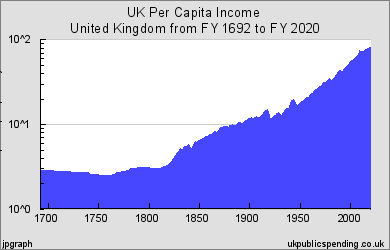
If you look at the chart of British GDP per capita, you will see that per capita income was flat all through the 18th century and then took off in 1820. In other words the Brits managed to convert all potential economic growth into its empire and its war against France.
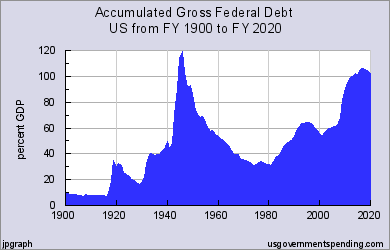
For the US, the two world wars of the 20th century involved an astonishing mobilization of national treasure as you can see from the following chart.
The Sea Change in National Debt
After World War II the US drew down its National Debt from 150 percent of GDP in 1946 to 30 percent of National Debt in 1980. Then the world changed. The Republicans decided to cut tax rates while winning the Cold War and developed the idea that moderate Republicans like Bob Dole were "tax collectors for the welfare state." The idea was that the only way to restrain spending was to starve the government of money, and that would never happen when the National Debt was low.
The Aftermath of the Great Recession
But then the universe changed in the Crash of 2008. As is normal in a big financial crash, the National Debt doubled, and quickly approached 100 percent of GDP. Because a Democrat was president, nothing was done to reduce the debt, except to fund Obamacare mostly outside of the federal budget.
What Happens Next?
Almost certainly the US federal government will default on its debt. This is because there is a profound difference between a National Debt that was incurred to fight a war, as in the old days, and a National Debt incurred to maintain entitlement programs. You can reduce military spending after a war; it has been done dozens of times. But you cannot reduce spending on goodies for the voters, so you have to do it with smoke and mirrors, by devaluation, inflation, and/or debt default.
The Difference Between the National Debt and Personal Debt
Despite the ubiquity of student debt and mortgage debt in modern American life, the fact is that personal debt is risky. With student debt you are betting on your future earning potential at a time when you don't have a clue what you'll earn. And with mortgage debt you are assuming that you can maintain your current job and that housing prices won't go down. If you are wrong, you get wiped out.
But National Debt is different. Here the politicians are betting the nation on the outcome of a war. If the politicians win they are national heroes; if they lose, the people's wealth is wiped out.
The Invention of the National Debt
Politicians started using banks to fund their wars towards the end of the Middle Ages. Edward III of England broke a few Italian banks, and Henry VIII used the credit of merchants in London to fund his wars.
But it was the Dutch that invented central banking in their war of independence of 1568-1648 against Spain. The key was the Amsterdam Exchange Bank that marketed and managed the debt of the nascent Dutch Republic.
Then in 1688 the Dutch invaded England and in four years founded the Bank of England, and birthed the English National Debt. In the next century the Brits ran their National Debt from nothing up to 250 percent of GDP just after the Battle of Waterloo in 1815, as you can see from the following chart.
Along the way the Brits built a global empire and ended the domination of France in Europe.
If you look at the chart of British GDP per capita, you will see that per capita income was flat all through the 18th century and then took off in 1820. In other words the Brits managed to convert all potential economic growth into its empire and its war against France.
For the US, the two world wars of the 20th century involved an astonishing mobilization of national treasure as you can see from the following chart.
The Sea Change in National Debt
After World War II the US drew down its National Debt from 150 percent of GDP in 1946 to 30 percent of National Debt in 1980. Then the world changed. The Republicans decided to cut tax rates while winning the Cold War and developed the idea that moderate Republicans like Bob Dole were "tax collectors for the welfare state." The idea was that the only way to restrain spending was to starve the government of money, and that would never happen when the National Debt was low.
The Aftermath of the Great Recession
But then the universe changed in the Crash of 2008. As is normal in a big financial crash, the National Debt doubled, and quickly approached 100 percent of GDP. Because a Democrat was president, nothing was done to reduce the debt, except to fund Obamacare mostly outside of the federal budget.
What Happens Next?
Almost certainly the US federal government will default on its debt. This is because there is a profound difference between a National Debt that was incurred to fight a war, as in the old days, and a National Debt incurred to maintain entitlement programs. You can reduce military spending after a war; it has been done dozens of times. But you cannot reduce spending on goodies for the voters, so you have to do it with smoke and mirrors, by devaluation, inflation, and/or debt default.

No comments:
Post a Comment