
What are we going to do about the National Debt? Right now, the US Federal Debt is about 100 percent of GDP. Back before the Crash of 2008 it was about 60 percent of GDP.
And that's not really the whole story, because Social Security and Medicare have unfunded liabilities estimated at $50 trillion on up. $50 trillion is about 250 percent of GDP right now.
And then, bless her heart, AOC wants to spend $90 trillion on the Green New Deal; that's 450 percent of GDP.
Actually, national debt at over 100 percent of GDP is not that scandalous. US Federal Debt went up to 120 percent in World War II.
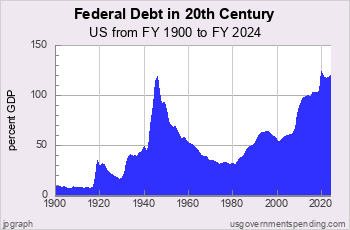 And then it went down.
The Brits took their national debt above 250 percent of GDP twice. The first time was at the end of the Napoleonic Wars; the second time was at the end of World War II. No problem -- if you win the war!
Running the federal debt up to 120 percent of GDP in World War II worked because the US ruling class of the the 1940s decided to go fight the war, and then after the war inflated and/or ran surpluses until they got the debt down. The ruling class was more or less united on all this, so The People didn't really have a voice as to whether they wanted to go to war, or whether in the aftermath they wanted more spending on programs or to drive down the debt as a percent of GDP. The ruling class decided for them.
But, in the 1970s, the ruling class split. The lefty side had started the Great Society in the 1960s to use government spending on programs and wanted that to continue, and the righty side wanted to cut tax rates but knew they could never persuade the American people to cut spending. It's been that way ever since.
Then we had the generational financial Crash of 2008, when the federal debt doubled as a percent of GDP. If you read books like This Time is Different by Reinhart and Rogoff they will tell you that this doubling of national debt in in the aftermath of an economic meltdown is typical.
But what do we do about the debt? I argue that if the ruling class is united it will pay down the national debt. If it is divided then it won't.
This makes sense, because if a united ruling class keeps the debt down then they keep the people fat and happy. But if the ruling class is divided and things start to go wrong, as they might when the state's finances are stressed by high levels of government debt, then there is always the possibility of revolution and riots in the streets.
Not good. For the ruling class or anyone else.
But why is the ruling class divided today? It is divided because one part of the ruling class has supporters that expect rewards in the form of government spending, and because another part of the ruling class has supporters that expect rewards in the form of tax cuts. And right now there is a standoff.
So really, the debt problem is really a symptom of a bigger problem, that the American people are divided on the question of spending and taxes. And really there is no solution until the rubber hits the road in inflation and/or debt default. That's because no red-blooded American right now is about to agree to cuts in spending on his Social Security or her Medicare. And no Republican can run for president without promising tax cuts.
So it will have to get worse, so that people have bigger things to worry about than their government checks or their tax bill.
Only then will our ruling class "do something" about the debt.
But note this: The Canadian Liberal government Did Something about the debt in the 1990s -- and got shut out of power for a couple of decades. The German Social Democratic government liberalized labor-market rules in the 2000s, and the SDP is now close to being the third largest party in Germany.
If you do the right thing, the voters will probably punish you at the ballot box. But at least you did the right thing.
And that's not really the whole story, because Social Security and Medicare have unfunded liabilities estimated at $50 trillion on up. $50 trillion is about 250 percent of GDP right now.
And then, bless her heart, AOC wants to spend $90 trillion on the Green New Deal; that's 450 percent of GDP.
Actually, national debt at over 100 percent of GDP is not that scandalous. US Federal Debt went up to 120 percent in World War II.
The Brits took their national debt above 250 percent of GDP twice. The first time was at the end of the Napoleonic Wars; the second time was at the end of World War II. No problem -- if you win the war!
Running the federal debt up to 120 percent of GDP in World War II worked because the US ruling class of the the 1940s decided to go fight the war, and then after the war inflated and/or ran surpluses until they got the debt down. The ruling class was more or less united on all this, so The People didn't really have a voice as to whether they wanted to go to war, or whether in the aftermath they wanted more spending on programs or to drive down the debt as a percent of GDP. The ruling class decided for them.
But, in the 1970s, the ruling class split. The lefty side had started the Great Society in the 1960s to use government spending on programs and wanted that to continue, and the righty side wanted to cut tax rates but knew they could never persuade the American people to cut spending. It's been that way ever since.
Then we had the generational financial Crash of 2008, when the federal debt doubled as a percent of GDP. If you read books like This Time is Different by Reinhart and Rogoff they will tell you that this doubling of national debt in in the aftermath of an economic meltdown is typical.
But what do we do about the debt? I argue that if the ruling class is united it will pay down the national debt. If it is divided then it won't.
This makes sense, because if a united ruling class keeps the debt down then they keep the people fat and happy. But if the ruling class is divided and things start to go wrong, as they might when the state's finances are stressed by high levels of government debt, then there is always the possibility of revolution and riots in the streets.
Not good. For the ruling class or anyone else.
But why is the ruling class divided today? It is divided because one part of the ruling class has supporters that expect rewards in the form of government spending, and because another part of the ruling class has supporters that expect rewards in the form of tax cuts. And right now there is a standoff.
So really, the debt problem is really a symptom of a bigger problem, that the American people are divided on the question of spending and taxes. And really there is no solution until the rubber hits the road in inflation and/or debt default. That's because no red-blooded American right now is about to agree to cuts in spending on his Social Security or her Medicare. And no Republican can run for president without promising tax cuts.
So it will have to get worse, so that people have bigger things to worry about than their government checks or their tax bill.
Only then will our ruling class "do something" about the debt.
But note this: The Canadian Liberal government Did Something about the debt in the 1990s -- and got shut out of power for a couple of decades. The German Social Democratic government liberalized labor-market rules in the 2000s, and the SDP is now close to being the third largest party in Germany.
If you do the right thing, the voters will probably punish you at the ballot box. But at least you did the right thing.

Another thing worth noting from your plot of Federal debt since shortly after independence is that the USA will not be joining in any (near-)existential or otherwise world-scale war until its debt is substantially reduced (say to 50% of GDP or lower). Let's hope no one else wants to start one before then.
ReplyDeleteBest regards