
After updating my usgovernmentspending.com with the new Trump budget, I am looking around me to see what other people think.
Here, for instance, is Donald Lambro complaining about "wasteful spending," such as Scott Pruitt flying first class, and the stupidity of $13 billion to fight opioid addiction and $18 billion for the wall, and the fantasy of imagining that we can cut $250 billion from Medicaid and $200 billion from Medicare.
Then there is Angelo Codevilla complaining that the extra $81 billion for defense isn't going to fix anything, not the waste in Afghanistan or the waste on the F-35 fighter. And we still don't have a decent anti-missile defense.
I'm sure that our Democratic friends are squawking like stuck pigs about little children going hungry in "our communities" and how this means the end of "our democracy."
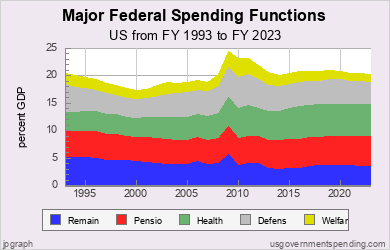
But here is the big picture on the federal budget spending, with pensions (i.e., Social Security) in red, health care in green, defense in gray, and welfare in yellow. All other spending is at the bottom in blue:
Here's the link to usgovernmentspending.com if you would like to muck around with this chart.
What you see in the chart is that basically nothing has changed, overall, in the last 25 years. Nor is it likely to change. Oh sure, there is a significant cut in defense spending in the 1990s. You see a steady increase in health care, starting in 2000. But the size of federal government spending started at 20 percent of GDP, swelled up to nearly 25 percent of GDP in the Great Recession, and has now declined down to about 20 percent of GDP again. So nothing has changed over the last 25 years.
We are going to continue with Social Security instead of letting Americans plan and save for their own retirement. We are going to continue with Medicare instead of letting Americans decide for themselves how much of a drug cocktail they want to spend their life savings on at the end of life. And we are going to continue the great and glorious Pentagon establishment and its flashy procurements despite the nagging suspicion that it is all going to flush down the toilet if we ever get into a real shooting war.
And everything else in the federal budget is chump change, even the dreaded yellow line of welfare (exclusive of Medicaid, CHIP etc.) at the top of my chart.
Here's what I think about all this. First of all, one fine day the whole federal budget will go south. Maybe it won't happen on our watch, maybe it will. But one thing is certain. If you or I have been relying on that government free stuff to keep coming, we are going to be in a world of hurt when the balloon goes up. For senior citizens like me it means "eating the paint off the walls" as they said after the end of the Soviet Union. And notice how they aren't saying anything about how senior Venezuelans are doing in the current meltdown. I wonder how the old folks are doing there, what with food scarce and health care non-existent?
Then there is the other problem. All these government programs are incredibly rigid and non-responsive. They go on forever without changing, without adapting to changing conditions. Until it's too late. The market system adapts every day to changing conditions, and we each have to adapt too, in our jobs, in our homes, in our families. Yet we have mewed up some of the most important social functions in government programs that cannot be changed.
How should we prepare for the financial challenges of life, from losing a job to educating the kids to saving for retirement? Who knows, because today we pay for most of it through inflexible government programs. And yet it is through meeting the challenges of life that we develop our humanity.
Yes, but what about the people that can't take care of themselves through no fault of their own? Surely we need government programs to take care of them.
But does government really take care of people unable to take care of themselves? Does it really help people to allow them to live for years without work? What about the crazy mass-shooters? What about the white working class dying of despair and opioid addiction? What about the miseries of people that lost their homes in the real-estate crash? What about the teenagers that can't get jobs because of the minimum wage? What about the huge cost of health care, courtesy of government regulation and credentialism? What about the abysmal educational achievements of African American kids after half a century of affirmative action and diversity programs?
See, I think that the point of humans as social animals is that social cooperation is about reducing the incidence of force. It is about people coming together and helping each other without someone saying: do this or else. Right now we have a federal government spending about 20 percent of GDP on the principle of force, because government is force, and state and local spending another 15 percent of GDP. Then we have the regulatory state that regulates everything that moves.
In my view, if you want to understand our problems then you have to start by thinking through what happens to a society when 35 percent of its interaction is under the knout of force, when little children are forced to go to government schools, when workers are forced to send 20 percent of their wages to government, when the relationship between worker and employer is fouled by an incomprehensible tangle of regulation.
Our lefty friends make a big deal about "militarism" and wasteful military spending. They are completely blind to the militarizing of everything else in this so-called "welfare" state.
People look at the federal budget and complain that nothing has changed. Then they look at school shootings and demand that the government "do something." Right now the US Senate is busy voting down all the possible immigration reform bills, so it looks like nothing will happen on that front.
People talk a lot about problems: sexual harassment in the workplace, marginalization of minorities, you name it. And each item on the agenda requires an increment of force.
I think that the problem is the opposite of what the activists say. I think the challenge is to find ways of dismantling the vast edifice of force that we have constructed over the last century, of which the federal budget is Exhibit A. I think the challenge is to implement new paths of social cooperation -- without resorting to the hammer of force.
Here, for instance, is Donald Lambro complaining about "wasteful spending," such as Scott Pruitt flying first class, and the stupidity of $13 billion to fight opioid addiction and $18 billion for the wall, and the fantasy of imagining that we can cut $250 billion from Medicaid and $200 billion from Medicare.
Then there is Angelo Codevilla complaining that the extra $81 billion for defense isn't going to fix anything, not the waste in Afghanistan or the waste on the F-35 fighter. And we still don't have a decent anti-missile defense.
I'm sure that our Democratic friends are squawking like stuck pigs about little children going hungry in "our communities" and how this means the end of "our democracy."
But here is the big picture on the federal budget spending, with pensions (i.e., Social Security) in red, health care in green, defense in gray, and welfare in yellow. All other spending is at the bottom in blue:
Here's the link to usgovernmentspending.com if you would like to muck around with this chart.
What you see in the chart is that basically nothing has changed, overall, in the last 25 years. Nor is it likely to change. Oh sure, there is a significant cut in defense spending in the 1990s. You see a steady increase in health care, starting in 2000. But the size of federal government spending started at 20 percent of GDP, swelled up to nearly 25 percent of GDP in the Great Recession, and has now declined down to about 20 percent of GDP again. So nothing has changed over the last 25 years.
We are going to continue with Social Security instead of letting Americans plan and save for their own retirement. We are going to continue with Medicare instead of letting Americans decide for themselves how much of a drug cocktail they want to spend their life savings on at the end of life. And we are going to continue the great and glorious Pentagon establishment and its flashy procurements despite the nagging suspicion that it is all going to flush down the toilet if we ever get into a real shooting war.
And everything else in the federal budget is chump change, even the dreaded yellow line of welfare (exclusive of Medicaid, CHIP etc.) at the top of my chart.
Here's what I think about all this. First of all, one fine day the whole federal budget will go south. Maybe it won't happen on our watch, maybe it will. But one thing is certain. If you or I have been relying on that government free stuff to keep coming, we are going to be in a world of hurt when the balloon goes up. For senior citizens like me it means "eating the paint off the walls" as they said after the end of the Soviet Union. And notice how they aren't saying anything about how senior Venezuelans are doing in the current meltdown. I wonder how the old folks are doing there, what with food scarce and health care non-existent?
Then there is the other problem. All these government programs are incredibly rigid and non-responsive. They go on forever without changing, without adapting to changing conditions. Until it's too late. The market system adapts every day to changing conditions, and we each have to adapt too, in our jobs, in our homes, in our families. Yet we have mewed up some of the most important social functions in government programs that cannot be changed.
How should we prepare for the financial challenges of life, from losing a job to educating the kids to saving for retirement? Who knows, because today we pay for most of it through inflexible government programs. And yet it is through meeting the challenges of life that we develop our humanity.
Yes, but what about the people that can't take care of themselves through no fault of their own? Surely we need government programs to take care of them.
But does government really take care of people unable to take care of themselves? Does it really help people to allow them to live for years without work? What about the crazy mass-shooters? What about the white working class dying of despair and opioid addiction? What about the miseries of people that lost their homes in the real-estate crash? What about the teenagers that can't get jobs because of the minimum wage? What about the huge cost of health care, courtesy of government regulation and credentialism? What about the abysmal educational achievements of African American kids after half a century of affirmative action and diversity programs?
See, I think that the point of humans as social animals is that social cooperation is about reducing the incidence of force. It is about people coming together and helping each other without someone saying: do this or else. Right now we have a federal government spending about 20 percent of GDP on the principle of force, because government is force, and state and local spending another 15 percent of GDP. Then we have the regulatory state that regulates everything that moves.
In my view, if you want to understand our problems then you have to start by thinking through what happens to a society when 35 percent of its interaction is under the knout of force, when little children are forced to go to government schools, when workers are forced to send 20 percent of their wages to government, when the relationship between worker and employer is fouled by an incomprehensible tangle of regulation.
Our lefty friends make a big deal about "militarism" and wasteful military spending. They are completely blind to the militarizing of everything else in this so-called "welfare" state.
People look at the federal budget and complain that nothing has changed. Then they look at school shootings and demand that the government "do something." Right now the US Senate is busy voting down all the possible immigration reform bills, so it looks like nothing will happen on that front.
People talk a lot about problems: sexual harassment in the workplace, marginalization of minorities, you name it. And each item on the agenda requires an increment of force.
I think that the problem is the opposite of what the activists say. I think the challenge is to find ways of dismantling the vast edifice of force that we have constructed over the last century, of which the federal budget is Exhibit A. I think the challenge is to implement new paths of social cooperation -- without resorting to the hammer of force.

It's good to be reminded of the excellent and helpful government expenditure data that Christopher Chantrill provides, not only on the USA government but also on the (for me more directly useful) UK government.
ReplyDeleteOn the issues he raises from part-way through his article, I find this linked plot gives even more worrying information. The changes I have made are to move from just USA Federal expenditure to all USA government expenditure; also to start the plots in 1950.
We then see clearly the rising total trend, from below 30% of GDP until around 1970 to peaks above 35% from the early 1980s and a more solid tendency above 35% from 2008 (lasting beyond the government actions and lowering of GDP during the Great Recession). The increases come from the introduction of government funded pensions and health-care; even earlier from growth in Remaining Spending. There is actually a drop in defence expenditure as a proportion of GDP over the period - caused variously IMHO by the ends of: WW2 knock-on effects, the Vietnam War and the Cold War.
I personally find this trend very worrying, over the long term, of a general increase in government expenditure.
However, if you think the USA has problems, try the UK. Here total government expenditure has been, since 1940, below 35% of GDP for just two (separated) years - the first in 1989 towards the end of the Thatcher government; the second by under one tenth of a percent in 2000 and a status soon to be lost by the ongoing Blair government.
Best regards