Monday, September 18, 2017

Maybe The Frankfurt School Guys were Charlatans

In the last few years I've taken the time to read the landmark titles of the Frankfurt School, principally The Dialectic of Enlightenment by Max Horkheimer and Theodor Adorno, and The One Dimensional Man by Herbert Marcuse.

So I have a rough idea of what they were all about.

Now I am reading The Frankfurt School by Zoltán Tar, a 1985 book by a chap from CCNY. And as I come towards the end of the book, I am coming to think that Dr. Tar regards the Frankfurters as lightweights, that were really writing about their exile than about the world as such.

That's because the Frankfurt School guys were mostly Jewish, and had to get out of Germany in 1933. Horkheimer and Adorno found their exile in the US particularly trying. I suspect it was because in Germany they were Somebodies, but in the US they were Nobodies.

For my money, the important book is Dialectic of Enlightenment. It looks back at the Enlightenment and realizes that the knowledge it brought was not just sweetness and light. "What men want to learn from nature is how to use it in order wholly to dominate it and other men." That's the money quote from Dialectic. You could say that it is hauntingly familiar.

It is really the same story as Adam and Eve in the Garden of Eden. You cannot stay in the Garden of Eden once you have eaten from the Tree of Knowledge.

Actually, we humans mostly recognize that our knowledge is a double-edged sword, for knowledge is the ability to destroy as well as create. That is why we moderns are deeply concerned with out impacts on The Climate, although humans have been mucking about with the environment ever since the first human set fire to the forest to make a convenient habitat for the animals he hunted.

Aside from the restatement of the Garden of Eden myth, the Frankfurters tended to shallowness. That is what I get from Tar. There is the effort to hang onto Marxism. I think that intelligent people should have started to move away from Marxism about the time that the marginal revolution exploded Marxist economics. And certainly by 1920 when it was clear that the proletarians identified with their nations before their class.

But the events of the years between the World Wars were so distressing to lefty intellectuals that they had to invent a narrative to explain it all away. That narrative is Fascism.

I suppose that if you believe that your ideas are a perfect reflection of the arc of history then the utter bungling and nightmare of the interwar years demands an explanation, and that explanation must explain the disaster as an outburst of demonic forces rather than the utter uselessness of lefty politics.

For instance, it is clear that the Frankfurt School intellectuals thought of themselves as standing athwart bourgeois-capitalist history shouting stop. In fact, the bourgeois-capitalist system had co-opted many of the ideas of the left and put them into practice in government social-insurance programs. Bismarck's social insurance legislation dates from the 1880s, and the British National Insurance Act from the 1906 Liberal government. In other words, lefty ideas were getting a fair shake, even before 1914.

But after World War I the politicians made a hash of things. In Germany they failed to match spending with revenue (a real problem for all social-democratic regimes) and put the nation through a ruinous inflation. In Britain they tried to return the pound to its pre-war parity with a ruinous deflation. In the US the politicians and placemen at the new Federal Reserve Board mucked up their first stock market crash by not acting as the lender of last resort, and thus precipitated the Great Depression.

Great going, guys!

So the average person was looking for someone to get them out of this mess. I suspect this urge is embedded deeply in the human consciousness: when your patch of land is threatened by an existential peril your little tribe unites around a strong leader that can mobilize the tribe in a fight for survival. That is all that is needed to explain interwar fascism.

But the lefty Frankfurt School intellectuals, like lefties everywhere, needed a different explanation. They wanted to blame it all on bourgeois capitalism and the middle class. They needed to know that but for the bloody bourgeoisie, everything would have turned out right. Of course they did. The left's one and only narrative is that the middle class -- from which they come -- is to blame for everything.

So Adorno got some money to do a survey and published The Authoritarian Personality. It found that the middle class was responsible for fascism, because of its tendency towards authoritarianism. Here is the blurb from Personality's Amazon product page.
Bringing together the findings of psychoanalysis and social science, this book grew out of an urgent commitment to study the origins of anti-Semitism in the aftermath of Hitler's Germany. First published in 1951, it was greeted as a monumental study blazing new trails in the investigation of prejudice.
They used a survey of 2099 people to construct various personality scales, including an Anti-Semitism Scale and a Politico-Economic Conservatism Scale, adding up to an overall F-Scale, or Fascism Scale.

The authors detected nine different facets of the authoritarian personality: Conventionalism, authoritarian submission, authoritarian aggression, antiintroception, superstition and stereotypy, power and "toughness," destructiveness and cynicism, projectivity, and sex.

Well. And can you spell Antifa? If the idea weren't taken already, I think some chap would write a play about 21st century leftist activism and its witch hunts and call it The Crucible.

Of course, we are seeing a repeat of the leftist obsession with interwar fascism in the move to explain Trump. For years liberals have been deaf to the concerns of everyone except their social issues chorus and their marginalized minorities, and now they are shocked, shocked, that a guy has come along and told the great unwashed middle class that he cares about people like them. No kidding! You think that people might rally to a chap like that?

That is all the narrative needs to be! You don't need a lumbering great theory with a tendentious survey. You don't even need a fancy theory to explain the anti-Semitism of the Nazis. Any politician understands that to unify your people you need to raise up the spectre of an enemy. If the Jews had not been close to hand, the Nazis would have demonized some other group. Liberals do this all the time with their relentless attack on racists, sexists, and homophobes. And now "white supremacists."

The great problem of our age is that, with the constant demolition of left-wing ideas in the remorseless cockpit of real life, lefty intellectuals keep grabbing for a straw that restores for a moment their need for a system to satisfy their deep longing for liberation and emancipation, and above all, justice.

And it just gets us deeper and deeper in a mess.

I picked up a piece by Black Swan guy Nassim Nicholas Taleb where he writes:
Survival comes first, truth, understanding, and science later[.]
But our modern welfare state and everything left of center is devoted to the idea that we don't have to put survival first: the economic problem is solved. And so lefties encourage millions of people to just suck on the milk-teat of government, rather than work out their own survival and prosperity.

Obviously, if Taleb is right, then the folks relying on government to solve the survival thing for them are going to be the first that get wiped out when the balloon goes up.

As in Venezuela, where the sensible got out years ago -- to the US, to Panama, to Chile, anywhere -- leaving only the folks that put their trust in princes to starve and suffer in the present economic disaster.

And then the left will come out with a new reboot of leftism to explain it all away.

Friday, September 15, 2017

A Rape Victim's Lament

In the aftermath of Education Secretary Betsy DeVos's decision to end the unjust Obama policy that removed sexual assault from the criminal justice system and assigning it to the tender mercies of lefty college administrators, we are getting the response you would expect from the national victim community.

A rape victim writes to NYT columnist Bret Stephens to complain that:
I’ve seen many pieces by sensible people on the violated rights of accused rapists. I have seen zero pieces from the center-right on the rights of sexual-assault victims. I have seen zero pieces that take the problem of sexual assault seriously.
Then this young head full of mush goes on to share her story. Are you sitting comfortably? Then I'll begin.
In college, I once blacked out drunk at a party and someone offered to walk me home. I don’t remember what happened after that, but when I woke up my clothes were on inside out. I started screaming.
This young lady may have seen "zero pieces that take the problem of sexual assault seriously," but then she is young and foolish, and she talks in the language of left-wing "rights" so we know that she knows nothing about the world because, through no fault of her own, we assume, she has heard nothing, and learned nothing, about anything except tendentious rubbish filtered through the distorting filter of left-wing propaganda in her government schooling.

Contra this unfortnate young woman, I would say that the basic attitude of the center-right on sexual assault, particularly as it relates to college campi, is that the problem begins and ends with the "hookup" culture, in which young people get themselves blind drunk. In which the idea of courtship and dating goes out the window. In which young women are treated like meat. In which foolish young women find out, too late, that they are not cut out for the hookup scene. Because, as this young woman relates, "some part of me had died forever, and that I had been violated."

OK, now let's fill in the holes in that young woman's sexual education; let's talk about sexual assault down the ages.

In the hunter-gatherer era, according to War Before Civilization: The Myth of the Peaceful Savage by Lawrence H Keeley, a tribe could only exist while the men existed to defend the borders. If there weren't enough men to defend the border the tribe dissolved and the women and children got picked up by other tribes. And you know what that means.

In The Iliad the whole story revolves about the argument between Achilles and Agamemnon about who gets to keep Briseis, the princess Achilles captured when he sacked the city of Lyrnessus. If you read The Iliad, you will note that there is not the least mention of what Briseis thought about all this.

In the Odyssey the plot turns on Odysseus returning to Ithaca from the Trojan War. Along the way he is pursued by numerous hot immortal babes, goddesses and whatnot, and enjoys their favors. But his faithful wife Penelope is stuck at home being harassed by The Suitors. No fun and games for her. There is not the least whisper in the Odyssey about how this double standard is a monstrous demonstration of the power of the patriarchy.

If you read about the Vikings you will discover that their modus operandi was to sail their longships up the rivers of France and Britain and raid the villages and kill the men and sell the women and children into slavery. If these Vikings were selling their slaves on the great rivers of Russia, they might refresh themselves on the slaves they had for sale while waiting for a likely customer.

If you read about the end of World War II you will discover that it is reckoned that probably every German woman caught in the path of the Red Army was raped. Then there were the lucky ones, as told in A Woman in Berlin. They were able to survive by taking Russians, preferably officers, as lovers in the lawless month when Berlin was occupied by the Red Army and normal civilian government and civilian policing had collapsed.

Then there is the modern campus where, in the interest of sexual liberation, the whole culture of bourgeois courting has been thrown onto the dustheap of history, and the old rules, where men were expected to treat women with respect and women were expected to avoid being alone with a man, were abolished and replaced in due time with the absurd bureaucratic rules currently in force at universities which treat sexual encounter as a multiple-choice test.

The old rules, as suffocating and bourgeois and patriarchal as they were, were based on the eternal truth that men are beasts and will couple with anything that moves, and also on the eternal truth that women are suckers for any man that shows up and makes love to them. So the old rules put roadblocks in the way of beastly men, and insisted that young women be very careful about bestowing their favors.

We now know also that the value of the old rules lay not just in protecting women from sexual assault, after which something inside them would die. They also protected women from the scourge of sexually transmitted disease. We have found, in the aftermath of the sexual revolution, that STIs run rampant in a population where many people have multiple sexual partners. And the burden of STIs fall heaviest upon women, because many STIs make women infertile.

So the silly old culture in which young women "saved" themselves for the man of their dreams turns out to have a practical value, arising out of the basic science of epidemiology. A disease, any disease, needs "vectors" to infect others in order for the disease to multiply. The fewer the vectors the less chance there will be for an epidemic. So if the STI vectors stop dead before the implacable chastity of the vast majority of young women, so much the better for posterity. Settled science, old chap.

Unfortunately, the young woman that wrote to Bret Stephens probably doesn't know any of this stuff. I wonder why.

Thursday, September 14, 2017

Great Enrichment Means Creative Destruction

Here's a piece about how in California the union-backed legislature is pushing unionization on the tech industry and Mr. Subsidy Musk's Tesla electric-car gig. California Governor Jerry Brown tells Trump to keep his hands off California, Steven Greenhut writes, because, Brown says:
We’re the innovation capital, high-tech, agriculture, $40 to $50 billion industry. You don’t want to mess with California, because you’re going to mess with the economy.
Well there ain't gonna be no economy in California if you chumps keep piling costs and regulations on the tech industry, as in:
California is mucking around with billions in electric car subsidies, but amendments to the subsidy bill "would inject the state into an increasingly acrimonious union organizing campaign at automaker Tesla’s Fremont plant."
But suppose Tesla moves all  its operations to Nevada, where is is already building a battery plant?

Hey, what about  the unionized port workers, where
subsidies for cleaner equipment at the ports “cannot be spent on automated cargo-handling equipment,” reported the Bee, because “increasing port automation has been a major concern of port workers’ unions.”
 Here's another, where the food-workers union wants a bill that
would impose a new set of regulations on internet-based firms that deliver gourmet meals to a subscriber’s doorstep. The goal is to force these firms, which already are highly regulated by the state and feds, to be regulated by local health inspectors.
Then there are proposals that would force home-health workers to divulge their cellphone numbers, to make them easier to organize in unions.

The funny thing is that the left began with the line from Marx about the free proletarians being "hurled" off the feudal estates in the agricultural revolution. That is the problem whenever you are a serf working and living on some lord's estate. It may feel secure, because the lord observes all kinds of traditional rights of the peasants. But the day will come when  he doesn't need his peasants any more.

And yet their entire politics is based on pretending that now things are different. Only they aren't.

The day would come when the steel industry wouldn't need their overpriced workers any more.

The day would come when the manufacturers didn't need their unionized factory workers any more.

The day would come when the Democratic party didn't need its white working stiffs any more.

The day will come when the ports don't need their $150,000 crane operators any more.

And this is not to say that the world is a cruel place that always screws the working stiff.

It is to say that the Great Enrichment of the last two centuries occurred because of innovation that was not stopped by the political system. Or, to use a less polite word, the Great Enrichment was a process of "creative destruction," as proposed by Joseph Schumpeter. Or, to put it even more plainly, the great innovations of the last two centuries, on which our modern prosperity is founded, caused hardship  and misery to a bunch of people that had a pretty good gig going.

As often as not, the people affected by "creative destruction" have gone to the politicians to save them from the end of their good times. And as often as not, the politicians have helped stave off the inevitable for a few years.

In fact, there is no escape from the creative destruction of the price system. You may think that you are safe in your government job, or your corporate bureaucracy. And you might be; the good times may just roll long enough for you to exit in style.

But sooner or later the market will have its way, and the hardest hit will be the people that have succeeded in hiding from the market in big institutions that seem to protect them from the tides of the market system. That's because when you are hidden away in a big institution you may not developed skills that will serve when the balloon goes up and the big institution has to lay off its employees to stay solvent.

Outside of big institutions you have to mark your skills to market every day.

It's a pity that our ruling class refuses to teach the people this vital life lesson. Do not think you can hide from the market in some big bureaucracy. You are subordinating yourself to the agenda of some Big Man, and the day will come when he doesn't need you any more.

Trumpers beware.

Wednesday, September 13, 2017

Government Shouldn't Legislate Morality

Back in the day, before political correctness and the emergence of women as college administrators, liberals liked  to lecture us against "legislating morality."

I agree. So that means no welfare state. Because the welfare state is all about the moral imperative to help those caught in poverty through no fault of their own.

And as liberals tell us, government shouldn't legislate morality.

I was inspired to write this because of a minor point in Andrew Roberts' massive biography Salisbury: Victorian Titan about the life of Queen Victoria's last Prime Minister, Lord Salisbury. Around 1899, a minister in Salisbury's conservative government proposed pensions for elderly poor people. Well, why not? It's the right thing to do.

As it happened, there was no money for pensions because the government spent all its money and then some on the Boer War. So it was left to the great Liberal government of 1906 to propose National Insurance and old-age pensions as government programs.

But like the liberals said: government shouldn't be legislating (and taxing) morality.

What should the government be doing? It should be protecting us from existential perils. Like invasion, like urban gangs. Like murderers and rapists.

But what about aliens? Ronald Reagan asked Gorbachev about that.
“‘What would you do if the United States were suddenly attacked by someone from outer space? Would you help us?’”
“I said, ‘No doubt about it.’”
“He said, ‘We too.’”
Who knew?In other words, everyone understands about existential peril, and an alien invasion would unify the nations of the earth to fight the alien peril.

That is why liberals have come up with climate change as a new way to spend money and feel good about themselves. Climate change is presented as an existential peril, and it is no accident that our liberal friends present hurricanes as evidence of the existential peril of climate change that only government can save us from. Of course, climate change is also about "saving the planet" which is a moral, as well as existential, imperative.

Liberals do the existential peril thing on climate change because they instinctively understand that existential peril is the only real warrant for government action.

But what about the Elizabethan Poor Law? What about welfare? What about wage and hour laws?

Really, I don't think that they were about legislating morality.

The Elizabethan Poor Law, on my view, was a response to the flood of vagrants, "hurled" off the land by their improving landlords. They were becoming an existential threat to the Elizabethan regime, and needed to be neutralized. And the same applied to all the social legislation that began in the late 19th century. The working class wanted stuff, especially free education, and they were going to rip the place up if they didn't get it. So Bismarck enacted the first social insurance legislation, to  bring the working class into the system. And others followed. The socialists put a shiny veneer on this response to an existential peril by making a moral imperative out of helping the poor and the oppressed.

The trouble is that when the whole system matures you get what we have today. You have universal pension and health care programs that mainly benefit the middle class wage earner. And you have welfare for the poor that results in social disintegration with men that don't work and women that don't marry. And you have an inflexible system that cannot be reformed in the light of changing life expectancies because nobody will accept a reduction in the benefits that "they paid for."

Nothing will happen to middle-class entitlements until they run out of other peoples' money. And you know what comes next. It's the evergreen headline: "World Ends; Women and Minorities Hardest Hit."

So that is why I demand a separation of existential peril and moral imperative. The government's job is to deal with existential perils, real and imagined. Society's job is to deal with moral imperatives, such as looking after grandma and relieving the poor.

Actually, society does a pretty good job of cleaning up after existential perils like hurricanes. But government does a lousy job of responding to moral imperatives.

Yes but what about education? Good question, senator. In the first place we are doing a lousy job of educating the children of the poor. In the second place the Third World already does a pretty good job with "informal" urban schools that outperform the government schools and provide financial aid for the children of widows and abandoned women. In the third place, the current system of student debt is mad and bad and unjust. In the fourth place a lot of the education of teenagers could be replaced with corporate-sponsored apprenticeships and internships. Teenage kids could go to work and continue their learning, subsidized by the business system and saving the cost of government teachers and bureaucrats. And student debt.

What about pensions? Exactly. On my plan everyone would be encouraged to save at Fidelity and Vanguard for all the risks of life, from unemployment to end of life health care. And it would all be "their" money. One of the great injustices of the modern era is the sequestration of middle-class savings into government "insurance funds." But the problem is that the average punter can't access their own money, not as collateral, not as a rainy-day fund, not for nothing unless approved by the local government bureaucrat. So the whole thing becomes nothing but politicians buying votes with other peoples' money.

But what about the poor? Exactly. People thrown into poverty "through no fault of their own" would be succored by left-wing tech billionaires, on a completely voluntary basis, except that any tech billionaire that did not relieve the poor would be banished from polite society.

But I have a bigger point. It is about what government can do, and what it cannot do.

My point is that when government cranks up spending to meet an existential peril, like the Nazis or the Commies, it is perfectly capable of cranking down the spending when the peril is over.

But when government spends money on moral imperatives, it seems to be impossible ever to reduce spending. And while the reason given is usually moral, as in "the children," the real reason is almost always free stuff. When government goes on a moral crusade, it usually hands out lots of lovely free stuff, and finds it impossible ever to take that free stuff away.

And that, if you ask me, is a crying shame.

Tuesday, September 12, 2017

Thinking About the National Debt

I'll be talking to some folks about the National Debt tomorrow, so I thought I'd better get my ideas down first.

The Difference Between the National Debt and Personal Debt

Despite the ubiquity of student debt and mortgage debt in modern American life, the fact is that personal debt is risky. With student debt you are betting on your future earning potential at a time when you don't have a clue what you'll earn. And with mortgage debt you are assuming that you can maintain your current job and that housing prices won't go down. If you are wrong, you get wiped out.

But National Debt is different. Here the politicians are betting the nation on the outcome of a war. If the politicians win they are national heroes; if they lose, the people's wealth is wiped out.

The Invention of the National Debt

Politicians started using banks to fund their wars towards the end of the Middle Ages. Edward III of England broke a few Italian banks, and Henry VIII used the credit of merchants in London to fund his wars.

But it was the Dutch that invented central banking in their war of independence of 1568-1648 against Spain. The key was the Amsterdam Exchange Bank that marketed and managed the debt of the nascent Dutch Republic.

Then in 1688 the Dutch invaded England and in four years founded the Bank of England, and birthed the English National Debt. In the next century the Brits ran their National Debt from nothing up to 250 percent of GDP just after the Battle of Waterloo in 1815, as you can see from the following chart.


Along the way the Brits built a global empire and ended the domination of France in Europe.

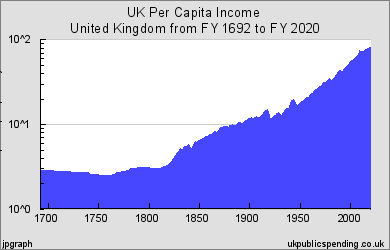
If you look at the chart of British GDP per capita, you will see that per capita income was flat all through the 18th century and then took off in 1820. In other words the Brits managed to convert all potential economic growth into its empire and its war against France.

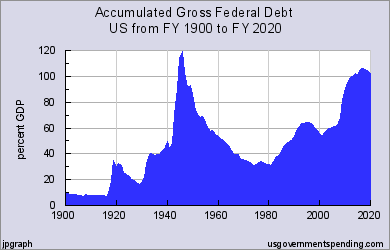
For the US, the two world wars of the 20th century involved an astonishing mobilization of national treasure as you can see from the following chart.


The Sea Change in National Debt

After World War II the US drew down its National Debt from 150 percent of GDP in 1946 to 30 percent of National Debt in 1980. Then the world changed. The Republicans decided to cut tax rates while winning the Cold War and developed the idea that moderate Republicans like Bob Dole were "tax collectors for the welfare state." The idea was that the only way to restrain spending was to starve the government of money, and that would never happen when the National Debt was low.

The Aftermath of the Great Recession

But then the universe changed in the Crash of 2008. As is normal in a big financial crash, the National Debt doubled, and quickly approached 100 percent of GDP. Because a Democrat was president, nothing was done to reduce the debt, except to fund Obamacare mostly outside of the federal budget.

What Happens Next?

Almost certainly the US federal government will default on its debt. This is because there is a profound difference between a National Debt that was incurred to fight a war, as in the old days, and a National Debt incurred to maintain entitlement programs. You can reduce military spending after a war; it has been done dozens of times. But you cannot reduce spending on goodies for the voters, so you have to do it with smoke and mirrors, by devaluation, inflation, and/or debt default.

Monday, September 11, 2017

The Liberal Ruling Class Don't Know Nothing

LIberal Mark Lilla has a book out, The Once and Future Liberal, an expansion of a New York Times article "The End of Identity Liberalism" from last November. He gives a flavor of the book in The Wall Street Journal: "The Liberal Crackup."

But the WSJ article rather shows just how Mark Lilla doesn't get it.

He writes that
Ronald Reagan almost single-handedly destroyed the New Deal vision of America that used to guide us. Franklin Roosevelt had pictured a place where citizens were joined in a collective enterprise to build a strong nation and protect each other. The watchwords of that effort were solidarity, opportunity and public duty. Reagan pictured a more individualistic America where everyone would flourish once freed from the shackles of the state, and so the watchwords became self-reliance and small government.
Oh really. I'd say that Mark Lilla has a profoundly fantastical notion of life, the universe and everything. The point of the New Deal was a massive increase in government force. More taxes, more spending. More compulsion. You want a job? You pay into the government's Social Security program. You work under the shadow of labor laws that make a mockery of "employment at will." And in the 1960s the Democrats ratcheted up another big notch with Medicare and welfare expansion. Some solidarity; some opportunity; lots of public duty, as in taxes and subordination to government experts.

Has any of that stuff been repealed? Reagan may have "pictured a more individualistic" America, but it sure did nothing to roll back the power and the force of government. And Obama cinched the wrench another notch with Obamacare.

Here's another whopper.
To meet the Reagan challenge, we liberals needed to develop an ambitious new vision of America and its future... Instead we got tangled up in the divisive zero-sum world of identity politics, losing a sense of what binds us together as a nation.
This is why I insist on the catchphrase: Politics is Division. Liberals have always practiced identity politics as the highest and noblest form of politics, because their politics advocated for the poor and the marginalized. So to say that anything changed after Reagan is to be willfully blind.

For half a century before 1965 liberals practiced class identity politics, advocating for the workers and damning business owners and capitalists to hell and back again. In doing so they divided workers from owners very effectively, and loaded up the workers with swingeing taxes on their labor by pretending that the taxes were really paid by management.

Then, with the civil rights acts of the 1960s liberals changed horses. They dumped the working class as narrow and bigoted, and cranked up their race and sex identity politics. Nothing has changed. Liberals are still ruthlessly dividing America and telling each other that their divisive politics is bending the arc of history towards justice.

But, and here Lilla starts to make sense, the liberal identity politics started to migrate from just dividing people in a normal political way to being a personal identity politics.
[Liberals] wanted their political engagements to mirror how they understood and defined themselves as individuals. And they wanted their self-definition to be recognized.
Well, yes. This is why I call liberals "People of the Creative Self" in my reductive Three Peoples theory. Liberals believe that the meaning of life, the universe and everything is found in what liberal philosopher Charles Taylor calls "expressive individualism," the personal expression of beliefs and creativity in the public square. Thus liberal politics becomes less about what we are forcing the American people to do with our government programs and regulations, but more about what the whole thing means to me, the liberal in question.

And because liberalism is a secular religion, the daily practice of politics becomes the daily practice  of what it means to be a good or, as they say, "ethical" person. Thus people that do not practice the faith are bad people and their utterances are stigmatized as "hate speech" and they are expelled (or rather excommunicated} from the secular religious community.

The problem with this has been played out on the big screen of the two most monstrous political regimes in all history, the Soviet Union and the Peoples Republic of China, and immortalized in the work of George Orwell.  When secular religion is welded together with government you get a situation in which disagreement with the ruling-class's secular ideology becomes identical with opposition to the government. Sinners are also traitors.

Meanwhile Mark Lilla longs for "classic liberal ideas like citizenship, solidarity, and the common good" that the new generation of leftists have lost.

But Lilla does not understand that citizenship cannot survive when every citizen is fenced around with detailed and intrusive regulations. Solidarity is not solidarity when it is compelled, and the ciiizen is reduced to the status of an army draftee. The common good is not common unless people are free to disagree and negotiate, without fear of humiliation from the local activist, about the nature and the composition of the common good.

My Three Peoples theory makes this obvious truth implicit in its view of society. Clearly, the folks in the middle, the People of the Responsible Self, are the citizens who, by their relative independence and responsibility, can come into the public square and debate questions of common concern without looking behind them to worry about what their boss or the local political bully might do to them. But the People of the Subordinate Self are not yet citizens: they are still subjects. They do not have the relative independence that allows them the space to disagree with their betters. They know that their job is to support their political or economic patron as part of his rank-and-file political army. And they do.

Then there are the People of the Creative Self. Their culture is the culture of "expressive individualism." But for too many of them, the only way of expressing themselves is in political activism, and advocating for some government program or regulation. But this means that their individual creativity can only express itself by dividing people into us and them, because Politics is Division, and by forcing their world view on other people, because Government is Force.

So my political agenda comes naturally out of my view of the Three Peoples. For the People of the Subordinate Self, we should encourage the development of the bourgeois ethos, as recently suggested by Dr. Amy Wax to universal horror. When you acquire the bourgeois ethos of individual responsibiiity then you become a citizen, enrolled in a sense of national solidarity, with an interest in developing and negotiating a notion of the common good.

For the People of the Responsible Self we encourage the notion of the creative ethos, going beyond the simple agenda of following the rules, going to work, and obeying the law. And we encourage a gentle kindness toward the People of the Subordinate Self that only know that they are oppressed and exploited by their "betters."

For the People of the Creative Self we discourage the temptation in the practice of creativity to imagine that you are a god. Creativity is in fact a very dangerous thing, and the chances are that your own individual effort at creation will turn out to be a disaster -- just like most business startups and most political revolutions. So the one really important thing for People of the Creative Self is humility, to think about the possibility that the Grand Creative Plan might end up a Grand Creative Disaster and that millions of people might suffer and die in the aftermath.

When we ventilate these ideas two thoughts seem to come forth. The first is that liberals are idiots that know nothing, because they are pompous ruling-class functionaries that don't get out much. The other is that if there really is to be a revolution of the deplorables, liberals like Mark Lilla will be the last to know, and probably not realize what is happening until it is too late.

Friday, September 8, 2017

Who Will Bell the Lefty Cat?

Even the dark knight himself, Steve Bannon, has to do the ritual washing of hands when it comes to right-wing extremism. Axed by the 60 Minutes on-air talent the ritual question of whether he was now, or ever had been soft on the radical right, he answered:
[T]he Neo-Nazis and Neo-Confederates and the Klan, who, by the way, are absolutely awful – there’s no room in American politics for that.
Now Steve Bannon is a smart guy, so if he is saying that rather than:
Look, there are always kooks and clowns on the radical extremes. In a way a healthy politics demands it. But here is what I worry about. I  worry that you fake news journalists spend all your time asking me to disavow the radical right. I don't recall ever hearing about a fake news journalist demanding that the racist Representative Maxine Walters to disavow the racist Black Lives Matter. Why is that?
There must be a reason.

Yes, why is it that fake news journalists aren't out there attacking Antifa and the Black Block that are actually rioting and physically attacking "peaceful protesters?"  Why aren't they axin' lefty politicians from Kamala Harris to Bernie Sanders "have you now or have you ever had a soft spot for the radical left organizations like Black Lives Matter and Antifa? Well because.

I think that the reason we have Donald Trump as president is precisely because the conventional conservative movement and the conventional Republicans have failed to protect ordinary people from the vile accusation of racism. And the vile accusation of sexism and homophobia and hate speech and I know not what else.

What this nation needs is a political genius that can turn the left's rhetoric back on itself, to accuse the accusers, to tell the racists on the left that they are the haters and the racists. That Black Lives Matter is black racism. That feminism is sexism. That the gay mafia is heterophobia.

Look I get it. If you are a moderately dull scion of the professional middle class, from Marx to Lenin to Castro, and you have have appetite for power, the go-to strategy since at the latest 1848 is to advocate for the Wretched of the Earth: the poor helpless working class, poor helpless women; poor helpless non-whites; poor helpless gays; poor helpless coionized peoples. Now the well-born scions of the professional middle class are advocating for illegal immigrants and Muslims.

It would be much harder to do something really useful, like invent a new product, build a business, start a family. Or even restore the wasteland that is Detroit, Michigan. Really today's political activist is merely the modern equivalent of the young feudal lord bucking against his king. Because rebellion is the obvious thing to do if the king won't ransom the young lord's prisoners home.

I like to think that politically we are presently in a Panic, like the 1907 Panic when Belle da Costa Greene, J.P. Morgan's African American librarian asked him to tell the folks what to do to get the nation out of the crash. And Morgan is said to have replied that
I don't know what to do myself, but sometime, someone will come in with a plan that I know will work; and then I will tell them what to do.
Well, I don't know about that, because the solution to every Panic is to cover the uncertain credit of troubled financial institutions with the credit of a bigger, sounder institution. And these days that means the credit of the United States government, as in guaranteeing the trillions of dollars in money market mutual funds during the Crash of 2008.

But the solution to the 150 year Panic where nobody has the guts to tell lefties to put it where the sun don't shine, is that someone, somewhere has to brush back the vile accusation of racism, or right-wing extremism and live to tell the tale.

In that moment the sun will come out, the fake news journalists will turn on a dime, and we will all "move forward into broad, sunlit uplands."

Meanwhile, I am sitting in my library goggling at Belle Greene and wondering if she is really as Portuguese as she pretends, and waiting for that chap to turn up with a plan.