Tuesday, August 20, 2013

What "Emerging Democratic Majority?"


Ever since 2004 the Democrats have been assuring us that we are on the cusp of The Emerging Democratic Majority.  Yeah, there's a book by John B. Judis and Ruy Teixeira.


Obviously, a chap like me cannot believe such a thing because if I did, what would be the point of being a conservative?


The basic idea is that minorities, women, and educated young people are all trending Democratic, so look out ageing white men.


But there's just one thing, as TV detective Columbo used to say.


If the whole world is trending Democratic why does the president have to flog the black community into the Democratic column with racist incidents like the beer summit and the Trayvon Martin case?


If women are trending Democratic why do Democrats have to terrify women into believing that Republicans want to take their contraception away?


And if students are trending Democratic why is it necessary to make a big deal about student loans?


Shouldn't it just be obvious that the liberal way is the right way?


If you look at what Democrats do instead of what they say, you'd think that Democrats are scared to death of getting into a permanent minority, so they figure they have to flog every potential advantage from race identity to voter registration.


Which means that they are not in the catbird seat as they pretend.


In fact, of course, President Obama won reelection by only four points.  In fact, the US House of Representatives has a Republican majority.  In fact, state legislatures and governors have been trending Republican for years.


The reason that young 'uns and blacks and women have been trending Democratic is because only Democrats have their ear.  If you're a black then racial solidarity requires to you identify as Democrat.  If you are a single woman, practical considerations require you to rely on the government safety net rather than the spousal safety net.  If you are an educated youth then you've been listening to unionized teachers since kindergarten.  How you you think that unionized teachers with government pensions and tenure are going to vote?


Under the Obama administration these good folks are going to find out that Democratic governance does not improve their lives.  They are going to find out that politicians and their cronies are always and everywhere corrupt unless you tirelessly expose their shenanigans.  They are going to find out that politicians don't have a clue about the economy or education or health care or anything else.


That's because politics is good for only one thing: riling people up for a war.  You can learn that the easy way by reading a few books, or you can learn it the hard way in the aftermath of the inevitable political failures.


Bottom line: look for a reversal on that glorious Democratic majority in the next few years.

Monday, August 19, 2013

Conserrvatives Don't Get It says Liberal


Conservatives are already responding to Mike Konzcal's "Conservatives don't get that some problems are public, and it's hurting them" in the Washington Post.


Liberals, on the other hand, believe that, e.g., "unemployment is a public problem... because the individual firm, the individual himself, is powerless to cope with the complexities in times of stress."  That's how Bill Buckley put it, according to Konzcal.


OK, so now we have to define the difference between "public" and "private."  Konzcal uses John Dewey:


Dewey argued that the public is involved wherever an action between two people has consequences “that extend beyond the two directly concerned.”

Then off he goes critiquing conservatives for saying that government shouldn't provide a safety net,  that shaming the poor is better than a government response,  and that talk of inequality belongs in "quiet rooms."


Ah yes.  Inequality, President Obama's big line.  And, "for liberals, inequality is a public problem."


Huge inequality can make us more vulnerable to economic instability, and a weak middle class makes stronger recoveries and innovations less likely to happen. Huge inequalities can “distort our democracy,” making it harder for government to answer the needs of the people. These supplement other arguments like inequality can cause severe deprivation, stigmatizing, unacceptable forms of domination and block equality of opportunity.

But conservatives don't want the government to do anything about inequality.


Conservatives spend a lot of time discussing how inequality isn’t as big as we think, or how the poor have a much better life because certain durable goods are cheaper, or how austerity and liquidation are better for the overall economy than stimulus. But what they really think is that these don’t belong in the realm of the public, and that’s the realm of policy.

You'd expect that a liberal like Konzcal would make a dog's breakfast of what conservatives really believe, so let's pick over the mess he's created.


First of all, conservatives don't think in terms of the polarity of "public" and "private."  We believe that almost all human acts, especially economic acts, are social, in the sense of being not private, merely the business of one or two people, but public, in the sense that every economic act has repercussions throughout the economy.  That's what a free economy means as prices are transmitted throughout the society of producers and consumers.


The polarity that conservatives emphasize is the polarity between government and non-government, between force and voluntary cooperation.  What lies behind the benign notion of a "public problem" is the idea that voluntary cooperation has failed and force is the only solution.  In other words, liberals use the idea of "public" as a euphemism for "government" and "force."


In the conservative universe everything is a "public problem," that is, a problem that people might want to discuss in the public square.  But as soon as we are talking about government action then we are not really talking about a "public problem" any more.  We are talking about what kind of force to apply, what Lenin called "who whom."


Conservatives believe that force is usually the wrong medicine to apply to a social wound.  Take inequality.  Conservatives believe that there is benign inequality and malignant inequality.  The benign kind is the wealth acquired by Bill Gates and the late Steve Jobs.  They made spectacular fortunes by making computers and iPhones that transformed peoples' lives and transformed the economy.  Good for them.  Then there is the malignant kind.  It's the difference in the wages between unionized and non-unionized workers.  The difference in wages between tenured professors and adjunct faculty.  The difference in compensation between pensioned, tenured government employees and casual laborers.


Notice the unseen force behind the malignant kind of inequality?  It's government.  It's government that allows some employees to form a labor monopoly.  It's government that supports academic tenure.  It's corrupt politicians that do corrupt deals with government union leaders in return for political support.


So it's all very well to talk about "public problems" but what if government action makes them worse?  That's the missing link in Mike Konzcal's world view.  He assumes that large-minded people can sit down at a table and construct another government program to fight inequality, and good things will flow.  But what if the opposite is true?  What if today's inequality is the result of 50 years of liberal responses to "public problems" that made things worse?  That's what conservatives are talking about when we mutter on about "unanticipated consequences" of government actions.


For instance, conservatives think that the big problem with the health care system is that 60 years of government intervention since World War II has created a monster.  We think that the monstrosity begins with the fact that most people don't pay for their health care: the insurance company does.  And so people don't pay attention to the hospital bill the way they pay attention to the grocery bill.  And we think that Obamacare will just make things worse and complicate an already complicated system of subsidies and third party payments with even more cross-subsidization.


We notice that, whatever the nature of a "public problem" may be, the liberal solution always seems to be to hand out more free stuff to their political supporters.  And we wonder.


It's baloney to say that "conservatives don't get that some problems are public."  We understand that all problems are public, in the sense that we are social animals and all our actions are social and public.  We just don't think that most problems require a government solution.  We believe, on the contrary, following Adam Smith and a host of adepts, that the solution of public problems begins with personally working to understand and helping solve the other guy's problem, as in the Invisible Hand.


Liberalism, we believe, is based on the idea of the Clunking Fist, to force the other guy to bend to your will.  Because you are right and he is wrong.

Friday, August 16, 2013

Don't Forget the "Rule" in Ruling Class

We conservatives are fizzing these days with the term "ruling class," as in Angelo Codevilla's Ruling Class vs. Country Class, and John Hayward's "Real Class War" between Ruling Class, Dependency Class, and Everyone Else.  Our fizziness is founded on the notion that conservatives aren't Ruling Class, no sirree.

We all understand that today the appellation "ruling class" means liberals.  Or progressives.  And Jonah Goldberg's Liberal Fascism was and is the definitive description of our liberal ruling class masters and their corrosive apologies for liberal power.

Contra liberal power the whole argument of modern conservatism, starting with Edmund Burke's impeachment of the Governor of Bengal, Warren Hastings, is the limitation of the power of the ruling class.  Warren Hastings was the British pro-consul out in Bengal in the mid 1700s and he used his power to shake down the locals, including most memorably the Begums of Oudh.

Yes, I know, nothing changes.  Today our pro-consuls are shaking down the rich for political contributions, just like good ole Warren.

There is a problem with the conservative doctrine on the limitation of government power.  It means that people enraptured with political power won't become conservatives.  They will become Marxists, or socialists, or fascists, or race baiters, or global warmists single-payer health care activists -- anything that requires new powers for government and the ruling class or the next ruling class.

The point about a ruling class is that it rules.  The Latin "regere" means "to rule" as in regulate, regime, regimen.  To rule means to lay down the rules for the rest of us.  Period.  If you can't lay down the rules you aren't really the ruler.

Back in 1776 Adam Smith came up with a new and radical notion that human society might not need a real ruling class that ruled.  His Invisible Hand doctrine suggested that maybe people could engage in social cooperation via the market without having the clunking fist of government ordering the just price and the just wage and the just loan.  Maybe if the economy was founded on the notion that first each person had to make a product that other people wanted before they could scoop up their wages or profits, then we didn't need ruling classes at all!

It was the genius of Marx to offer a new justification for ruling-class power for the power-hungry young 'uns of the 1840s.  He said that the new capitalism that obviously transforming the world with steam power and unimaginable prosperity was really a horrible exploitation.  And only state power could keep it in check.  No wonder everyone loved him.  Because if you are an ambitious young chap with a taste for political power -- i.e. ordering everyone else around -- then there is nothing like a new political doctrine that bellows for the need for strong government power to keep the evil bourgeoisie from immiserating everyone into indigence.  Sign me up, Chuck!

Since Marx's time we have experienced enthusiasm after enthusiasm for unlimited ruling class power: Socialism, Progressivism, central banks, income taxes, universal government education, universal social insurance, civil rights, environmentalism, global warming.  Every one of these enthusiasms requires a strong ruling class with plenty of power to rescue us from disaster.

And we've had trenchant critiques, from the impossibility of calculating prices under socialism, to the bandwidth problem, to the unanticipated consequences argument, to public choice theory to supply-side economics.  And now we have George Gilder arguing that the secret to the future is knowledge over power.  We need to limit power and make it transparent and predictable, and we need to allow unlimited experimentation by business creators, because a new successful business is not so much a fount of profit as a creation of new knowledge.

The problem for conservatives is to develop a new political culture where it is unthinkable to propose and boost the unlimited kind of ruling class political power that young heads full of mush have loved ever since Marx.  There is a role for force, of course, in cracking the heads of street thugs and thug dictators -- in other words to wage war on all gangs of young male marauders.

But the role and the rule of force is limited.  Once you have dealt with the problem of thuggery, you don't need force; indeed force becomes counterproductive: that's why the Soviet Union is no more.  Once the thugs have been dealt with you need instead things like cooperation and trust and sincerity and the basic proposition of Adam Smith that if you want to thrive in the world you need to think and do something about satisfying other peoples' needs.

That is the great challenge for conservatives.  How do we construct and colonize the public sphere with a doctrine of political power that limits political power, that limits the "rule" in "ruling class?"  In other words, how do we sell the ruling class on a culture of political power that takes all the fun out of ruling?

Because, as the philosopher George Maroutsos said: You don't have power unless you've abused it.  Power without abuse is merely responsibility.  And who will fight and kill for mere responsibility?

How, in fine, do we make another Barack Obama impossible?  The terrifying thing about President Obama is not his apparent laziness, his divisiveness, his use of the IRS to punish his enemies.  It is that he is utterly oblivious of the totalitarian tendency of his politics, and his supporters in the educated liberal ruling class seem utterly unable to grasp where that politics leads.

That is our problem and it is scandalous that conservatives have not yet set the world ablaze with the glorious fire of our program of the limitation of powers.

Thursday, August 15, 2013

The 40 Year Republican Surge


With all the talk about The Emerging Democratic Majority it is easy to flinch before the jabs from the mainstream media that the Republican Party is Doomed, Doomed.


Or maybe not.  After all, what is a four point presidential win in 2012 telling us?  That President Obama ain't that popular, pal.


Now RealClear's invaluable Sean Trende has written a three parter on the Republicans: Are Elections Decided by Chance?, Are Republicans Really Out of Step?, and What If Party Makovers Don't Work? He argues that the reports on the death of the Republican Party have been grossly exaggerated.


In part one he shows that it almost looks as if elections are won by chance or the state of the economy. In part two he argues that Republicans and Democrats are not perceived by the voters as getting more extreme over time.  In fact the voters saw Romney as closer to their own political ideology than Barack Obama.  In part three he shows that party makeovers don't seem to make a lick of difference.


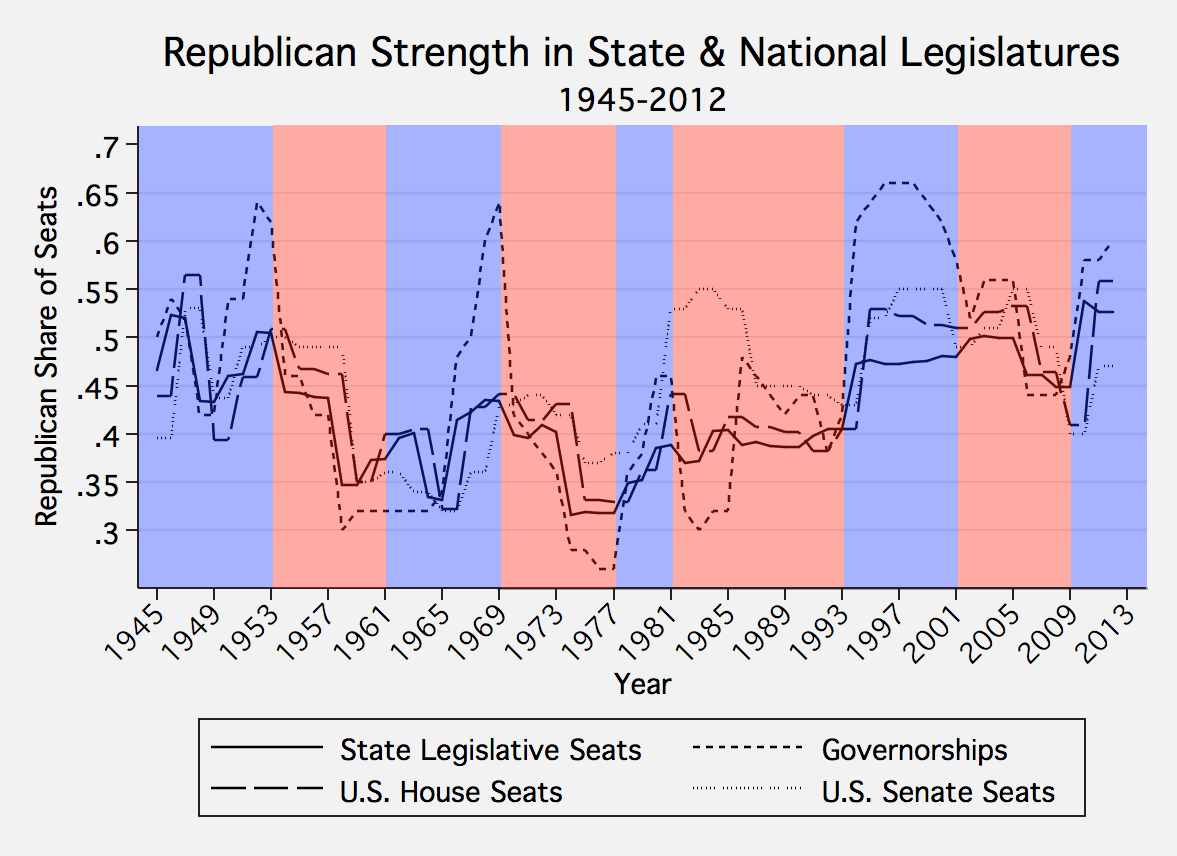
The takeaway chart for me was this one about party strength since 1945.


If you ask me the chart shows that the Republicans have been slowly growing in party strength at the state and national levels over the last 40 years since the nadir of the late 1970s.


You take a look at the chart and tell me: the chart, with all its noise and backing and filling shows a steady increase in GOP party strength.  Typically, of course, GOP strength improves towards the end of a Democratic presidency and declines towards the end of a Republican presidency.  But then there are the exceptions.


For all the noise the Democrats are making about taking back the House in 2014 it would be a bloody miracle if they did.  Maybe, after all, there will be a big bounce in the economy; maybe Obamacare will implement much better than expected.  Maybe the Republicans will get demolished by accusations of racism.


But I doubt it.  Much more likely is that we will see the rise of "privacy moms" uneasy about their cell-phone conversations ending up at the NSA and their health records getting hacked at the IRS.  Much more likely is the continuing disenchantment of the young 'uns realizing that they are the patsies of the Obamis, with unaffordable student debt and unaffordable health insurance and a lousy job market.  Much more likely is a gradual demoralization of the African American voters that have turned out so loyally for a president of their own race.


But all this is mere speculation.  For the reality we have to wait for November 2014 and November 2016 when the voters will speak.


Then it will be time to start the makeover lament all over again.  For the losing party of 2014 and 2016.

Wednesday, August 14, 2013

Liberals in "Worse than a Crime" Territory


All along, in the Obama era, I've had the feeling that the short-cuts and illegalities of the Obamis was, in the words of Talleyrand, worse than a crime, a blunder.


In other words, there's a reason that you obey the law and don't use the bureaucracy to harass your enemies.  It is to prevent the opposition from getting really riled up and unified.


Remember the 2000s.  The liberal activists used any questionable Bush administration act to whip their partisans into a frenzy, starting with the vote recounts in 2000 and continuing to the Bush Lied, People Died accusations about the entry into the Iraq War, and continuing with the eternal flap over Scooter Libby outing a CIA employee.  My liberal friends would give me a good flogging about these mild illegalities, which really weren't illegal at all.


Now we have President Obama asserting the right not to enforce laws like the Defense of Marriage Act or declining to enforce immigration laws.  The Obamacare rollout would be impossible without the president choosing which unworkable provision to delay or ignore next.


Today the Wall Street Journal edit page joins the chorus with a comment on the willful disregard of the law at the Nuclear Regulatory Commission.  The NRC is stacked with Obama and Reid cronies that don't want to go ahead with the Yucca Flats nuclear storage site.  Only problem is it's against the law, and the US Appeals Court has so ruled.


If the head of the NRC worked on Wall Street, "he'd be indicted" for this kind of shenanigans, writes the Journal.  At least if he were a Republican.


And then there's my favorite, little Lois Lerner, who seems to have been using her private email to conduct government business, like some others we know.


The point about all this petty illegality is that it makes it much easier for the Republicans to run in 2014 and 2016.  You may not want to give up your entitlements but you sure don't like government officials getting off with breaking the law and giving themselves exemptions and insider deals.


So I think that the "laws are for the little people" attitude in the Obama administration and the go-along-to-get-along attitude in the media amounts to a strategic error.


A government needs to demonstrate that it follows the rules and respects its opponents.  Not because it is right, but because it avoids riling up the opposition.


The liberal media needs to keep liberals in line just as much as the hated conservatives.


Same thing with Obama's recent executive decision to exempt Congress and its staff from Obamacare.  When people are suffering next year from the chaos of Obamacare they will not like the idea that their representatives and their staffers got themselves exempted from the chaos.  Even a low information voter gets that.


But you never know.  Maybe the American people will just sit there and take it and elect Hillary Clinton president in 2016 because she's a woman.

Tuesday, August 13, 2013

Time for Conservative Critical Theory

When the Left invented their modern theory of justice the idea was that the bourgeoisie and their bribed apologists in the government were systematically exploiting the new working class.  So more government was needed to liberate the working class and curb the bourgeoisie.

After the experience of 20th century Bolvshevism and fascism some of the more advanced thinkers on the Left -- we call them the Frankfurt School --  developed a more nuanced picture of modern society.  Now the cognoscenti proposed that government and business in league together represented a hegemonic power, a system that dominated society with political and economic power, the administrative state, that was supported by corporate media shoveling ruling-class propaganda at the masses using mass media.

To Jürgen Habermas, the second generation Frankfurt chappie, the mass media represented a deformation of the development of public sphere as in the 18th century, what he called “Öffentlichkeit” culture.  Mass media is not the same as intellectuals arguing in coffee-houses.

If operational behavior and communicative action form two aspects of social life, labor and language, as Habermas develops in Theory of Communicative Action, then the political and economic domination form a third aspect, a deformation of social relations.  This domination and deformation creates a need for "critical theory" to emancipate "the social agent [you and me] of deeply engrained patterns of thought that constrain self-understanding."  Writes David Ingram in Habermas and the Dialectic of Reason, "With the advent of modern class society, however, it [the emancipatory interest] has increasingly become a survival interest."

Couldn't agree more, Jürgi and Dave.  Now, if we apply a truly modern concept of modern class society from a recent article from John Hayward in "The Real Class War" at RedState.com, we are finally getting somewhere.  Forget Upper Class, Lower Class, and Middle Class.  How about this?
There really is a class war in America today, but it’s not between any of these Marxist bumper cars. The three real classes are the Ruling Class, the Dependency Class, and Everyone Else.

The Dependency Class is by no means filled with poor people. Far from it. And the Ruling Class is not at all limited to elected officials. Lots of people are becoming dependent upon government power and money. Many of them are extremely wealthy. The Ruling Class depends on them for its power. Everything the Ruling Class does is designed to protect its own interests, and keep its favorite dependent constituents happy. Other priorities are secondary, if they count for anything at all.
So the critical theory, the emancipatory thrust, has to come from the Everyone Else class.

Look, this is not rocket science.  Let's go to another Jürgi, the Austrian Georg Jellinek and his "three element" theory of the state.  It needs ein Staatsgebiet, ein Staatsvolk, eine Staatsgewalt.  In English, this means: state territory, state subjects, and state power.

Golly, it looks like great minds think alike.  In my theory of the state we have an armed minority (the Ruling Class) ruling over a subject people in some territory.  It maintains itself in power by taking money from the subject people (Everyone Else) to give handouts to its supporters (the Dependency Class).

We, the Everyone Else class, need to develop a critical theory to critique and defeat the present Ruling Class and its supporters, the Dependency Class.  We need to emancipate ourselves "of deeply engrained patterns of thought that constrain self-understanding."  In other words we need to purge ourselves of the mass media memes that constantly issue from the Ruling Class and their bribed apologists in the mainstream media, and we need to develop and distribute new ideas of freedom and liberation and the social healing of civil society to end the reign of injustice from the Ruling Class and its hired thugs in the Dependency Class.

End of story.

Monday, August 12, 2013

We Ain't Ready Yet for the "Liberty Amendments"


Today's the release day for Mark Levin's new book The Liberty Amendments.  And yeah, he's got a few, as in:


  1. An Amendment to Establish Term Limits for Members of Congress

  2. An Amendment to Restore the Senate

  3. An Amendment to Establish Term Limits for Supreme Court Justices and Super-Majority Legislative Override

  4. Two Amendments to Limit Federal Spending and Taxing

  5. An Amendment to Limit the Federal Bureaucracy

  6. An Amendment to Promote Free Enterprise

  7. An Amendment to Protect Private Property

  8. An Amendment to Grant the States the Authority to Directly Amend the Constitution

  9. An Amendment to Grant the States the Authority to Check Congress

  10. An Amendment to Protect the Vote


He proposes a constitutional convention for this important work.  Jeffrey Lord has all the details.


But I think that Mark is putting the cart before the horse.  I don't see anything like a political movement that could sustain such an ambitious program.  Not yet.


Levin considers this a Third American Revolution (the second was the Progressive movement of the 1880s that gave us the income tax and the directly elected Senate and the administrative state).


But I don't think we are anywhere close to that point.  That's because I think that revolution takes three stages.


  1. The first stage is the general ideological battlefield preparation.  With deep thinkers that are proposing a new order.  I don't think that we are anywhere close to achieving that.  We've had Mises and Hayek, and we've had Novak with the three sector idea and Berger and Neuhaus with the championing of civil society.  But we don't have a intellectual tour de force that puts it all together.

  2. The second stage is the young 'uns and the conquest of the cultural space.  Revolutions need young people.  As in the Napoleonic baby boom of the 1840s with Marx, and the 1960s baby boom tearing up the streets.  We don't seem to have anything like that today.  The Occupy movement was an AstroTurf joke.  Young people got all in a tizzy with Obama who, really, was a reactionary, going back to the failed and the corrupt.  Now they are in a daze what with their student loans and their joblessness and all.  There is no sign of a change in the culture among the young 'uns.  Then there are women.  In my view we can't have a cultural revolution without women, because they are guardians of the culture.

  3. The third stage is boots on the ground, the conquest of the political space.  That is what Mark Levin's new book is about, and you can see why I think he is way premature.


Let's get back to the woman question.  Women just aren't natural revolutionaries, ranting on about injustice and exploitation; they take the world as they find it and try to make it work for them.  Women don't get riled up by airy-fairy political principles, but by the needs of their loved ones.  You would think that women would be all riled up by the health care mess that hurts their ageing mothers, by the education mess that hurts their children, and by the collapse of marriage that hurts women.  Maybe they are, but we ain't seen any sign of a rebellion on the distaff side, except perhaps that the telling  point that the Tea Party is largely run by women.  My feeling is that the Third American Revolution will need the enthusiastic participation of women if it is to be a success.


You can see my interest in all this.  I'm writing a book that is trying to do Stage One, the ideological battlespace preparation.  I am trying to define just what we mean by the political sector, with government as force, politics as division.  I am trying to describe the reality of the modern economic sector, the fact that it has got over its shameful birth in plantation slavery and industrial discipline, and I am thinking about how to keep business out of the embrace of the political sector.  And I am discussing the importance of the moral/cultural sector, and how all these sectors need a civil society if human society is to flourish as a social thing rather that a hegemonic, dominatory thing.


I think we still have a lot of work to do in hammering out the basic principles of what we believe, and in making it compelling or at least challenging to the liberal ruling class.


Then and only then can we lay it all out before the suffering young 'uns and let them get cracking.


And then we will be ready for Stage Three, the actual implementation in a glorious series of constitutional amendments or their equivalent.  Because we need to rein in the unjust administrative state and its dominatory and hegemonic systems and restore the lifeworld of civil society.