
Theodore Dalrymple, the British doctor writer, keeps bringing up the name of Belgian Simon Leys, the sinologist writer who was born Pierre Ryckmans and died recently in Australia.
So I looked him up and bought Chinese Shadows, his book on the Cultural Revolution in China. The book mostly covers Leys' travels in China in 1972 after the worst of the Cultural Revolution was over and the army and the bureaucracy had regained control from Mao's teenaged Red Guards.
Of course what Leys wanted to look at in his travels, given that the average Chinese wouldn't talk to a foreigner at that time, was museums and temples and rare Chinese manuscripts. Not to mention books. Trouble was that all the museums were closed, most of the temples had been destroyed by the Red Guards, and the bookstores had nothing in them except the collected works of Mao, Stalin, and Enver Hoxha.
And the arts? The great tradition of Chinese opera had been reduced to Madame Mao's (she of the Gang of Four) six utterly dreadful Revolutionary Model operas.
There's a touching scene where Leys talks his guide into getting him to a bookstore that has some ancient manuscripts rolled up in the back room. When he shows up to look at the manuscripts a quiet assembly of other connoisseurs has gathered to look and appreciate this hidden treasure.
But I thought about the utter folly of thinking you can order society and its culture from the top with appropriate buzz-words and directives. There's a page where Leys rehearses a few slogans of Maoist China: "the five stories," the "Tachai spirit," "the four cleanups," "the eight-word constitution," "the three rightisms," and so on. And there is a description of an impossibly foolish irrigation project, that was supposed to have been conceived and executed by the workers, without a lick of help from engineers and technicians -- or earth-moving equipment.
Of course I think immediately about the utter folly of our social justice warriors, and the kiddies being taught Activism 101 at the university. As though the problems of the world can be solved by peaceful protests and political chants.
I mean, after the example of the Soviet Union and Maoist China, not to mention that black hole without electric light at night, North Korea, who can possibly think that activists can remake a country in the image of its revolutionary leaders with the help of chanted slogans?
The answer is, of course, that every new generation of kiddies can easily be taught to go out into the adult world and tear everything up, and they will do it willingly and vigorously without a clue about what they are doing on the strength of a few slogans and a rage to set the world right.
So I woke up in the night trying to think of a word to describe what we think we know.
Because really, we know nothing, and that has been confirmed for my by reading Werner Heisenberg's (he of the uncertainty principle that bears his name) Physics and Philosophy with an introduction by My Guy F.S.C. Northrop. Heisenberg talks about the difficulty of talking about the micro-world when the micro-world is just not like the normal world of everyday life that our brains and our language are programmed to deal with. He writes of the paradox of quantum mechanics:
But, the thing is that our knowledge about quantum mechanics works. The smartphone in your hand is proof of that. Take this equation:
All equations, all catchphrases, all political slogans, all religious beliefs, all of them are incantations. The question is: do they work? Shakespeare has the last word on this, in Henry IV Part One.
But the same thing applies to God, to politics, to the economy, to the dance of the sexes. We know nothing, but our incantations: God is love; power to the people; supply and demand; boy meets girl. These are all incantations, they are all attempts to call spirits from the vasty deep. But do they work? Will they come when you do call for them?
You will note that I have my own set of incantations: Government is Force; Politics is Division; System is Domination. The liberals down the street have their incantations in their #WeBelieve yardsigns: Black Lives Matter; Science is Real; Love is Love; Kindness is Everything. And the point is exactly the same as for Glendower or quantum mechanics. Does the concept work? Does it illuminate? Does it help you avoid the big beasts when you walk out in the world?
What is clear about all the incantations of the Maoist Cultural Revolution is that they were all rubbish. The world doesn't work that way, and never did. But this is nothing new. Most human incantations are rubbish, and soon get liquidated and sent to the ash-heap of history, because they don't work.
But some incantations are supported and enforced by political power, and they take longer to prove whether they can summon spirits from the vasty deep. When you have political power you can force people to repeat your incantation, and you can tell them that they better believe it or else.
And most of the people, most of the time, including me, will go along to get along, and even come to believe the incantations that their leaders have commanded them to recite.
But in the end, all knowledge is an incantation, that anyone can recite, and that few ever understand. The question is: does it work?
So I looked him up and bought Chinese Shadows, his book on the Cultural Revolution in China. The book mostly covers Leys' travels in China in 1972 after the worst of the Cultural Revolution was over and the army and the bureaucracy had regained control from Mao's teenaged Red Guards.
Of course what Leys wanted to look at in his travels, given that the average Chinese wouldn't talk to a foreigner at that time, was museums and temples and rare Chinese manuscripts. Not to mention books. Trouble was that all the museums were closed, most of the temples had been destroyed by the Red Guards, and the bookstores had nothing in them except the collected works of Mao, Stalin, and Enver Hoxha.
And the arts? The great tradition of Chinese opera had been reduced to Madame Mao's (she of the Gang of Four) six utterly dreadful Revolutionary Model operas.
There's a touching scene where Leys talks his guide into getting him to a bookstore that has some ancient manuscripts rolled up in the back room. When he shows up to look at the manuscripts a quiet assembly of other connoisseurs has gathered to look and appreciate this hidden treasure.
But I thought about the utter folly of thinking you can order society and its culture from the top with appropriate buzz-words and directives. There's a page where Leys rehearses a few slogans of Maoist China: "the five stories," the "Tachai spirit," "the four cleanups," "the eight-word constitution," "the three rightisms," and so on. And there is a description of an impossibly foolish irrigation project, that was supposed to have been conceived and executed by the workers, without a lick of help from engineers and technicians -- or earth-moving equipment.
Of course I think immediately about the utter folly of our social justice warriors, and the kiddies being taught Activism 101 at the university. As though the problems of the world can be solved by peaceful protests and political chants.
I mean, after the example of the Soviet Union and Maoist China, not to mention that black hole without electric light at night, North Korea, who can possibly think that activists can remake a country in the image of its revolutionary leaders with the help of chanted slogans?
The answer is, of course, that every new generation of kiddies can easily be taught to go out into the adult world and tear everything up, and they will do it willingly and vigorously without a clue about what they are doing on the strength of a few slogans and a rage to set the world right.
So I woke up in the night trying to think of a word to describe what we think we know.
Because really, we know nothing, and that has been confirmed for my by reading Werner Heisenberg's (he of the uncertainty principle that bears his name) Physics and Philosophy with an introduction by My Guy F.S.C. Northrop. Heisenberg talks about the difficulty of talking about the micro-world when the micro-world is just not like the normal world of everyday life that our brains and our language are programmed to deal with. He writes of the paradox of quantum mechanics:
It starts from the fact that we describe our experiments in the terms of classical physics and at the same time from the knowledge that these concepts do not fit nature accurately.We have to do that, because classical physics is merely a "refinement of the concepts of daily life and are an essential part of the language which forms the basis of all natural science." This is a pretty mind-blowing thing. We know that the sub-atomic world is nothing like the everyday world, and yet we use our everyday concepts to describe it. How crazy is that?
But, the thing is that our knowledge about quantum mechanics works. The smartphone in your hand is proof of that. Take this equation:
.What is it? I don't know. But you can check it out. But I will tell you what I think. I think it is an "incantation." Or even a line of poetry, written in the ideograms of mathematics. The only people that would know what it means are people with a deep and esoteric knowledge of math and quantum mechanics. But that is no different from temple priests in ancient Egypt with an esoteric knowledge of the scriptures.
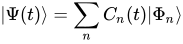
All equations, all catchphrases, all political slogans, all religious beliefs, all of them are incantations. The question is: do they work? Shakespeare has the last word on this, in Henry IV Part One.
GLENDOWERDo you see what I am getting at? The fact of modern physics is that we cannot imagine what is going on at the sub-atomic level; we only have the equations, which issued from the problem of black body radiation and the discovery that energy is discharged in "quanta" and yet behave like a wave. In other words, it takes two "concepts of daily life" to begin to get a handle of the concept of what is going on. But these two concepts, of a particle and a wave are, for us, contradictory. In our concepts of everyday life, we think that a thing can be either a wave or a particle, but not both. Until now. We talk about the sub-atomic realm using our "concepts of daily life" even though we know it is nothing like the everyday world or earth, air, fire and water.
I can call spirits from the vasty deep.HOTSPUR
Why, so can I, or so can any man;
But will they come when you do call for them?
But the same thing applies to God, to politics, to the economy, to the dance of the sexes. We know nothing, but our incantations: God is love; power to the people; supply and demand; boy meets girl. These are all incantations, they are all attempts to call spirits from the vasty deep. But do they work? Will they come when you do call for them?
You will note that I have my own set of incantations: Government is Force; Politics is Division; System is Domination. The liberals down the street have their incantations in their #WeBelieve yardsigns: Black Lives Matter; Science is Real; Love is Love; Kindness is Everything. And the point is exactly the same as for Glendower or quantum mechanics. Does the concept work? Does it illuminate? Does it help you avoid the big beasts when you walk out in the world?
What is clear about all the incantations of the Maoist Cultural Revolution is that they were all rubbish. The world doesn't work that way, and never did. But this is nothing new. Most human incantations are rubbish, and soon get liquidated and sent to the ash-heap of history, because they don't work.
But some incantations are supported and enforced by political power, and they take longer to prove whether they can summon spirits from the vasty deep. When you have political power you can force people to repeat your incantation, and you can tell them that they better believe it or else.
And most of the people, most of the time, including me, will go along to get along, and even come to believe the incantations that their leaders have commanded them to recite.
But in the end, all knowledge is an incantation, that anyone can recite, and that few ever understand. The question is: does it work?

No comments:
Post a Comment