Monday, October 11, 2010

What Women Don't Want

Liberal online Slate magazine has put one of those tiresome "whither feminism" pieces with a bunch of the usual suspects wondering whether Sarah Palin ought to be allowed to call herself a feminist.

Palin is of course profoundly anti-woman, according to Rebecca Traister:

While she may be a self-identified feminist, Palin's work and thinking is profoundly antifeminist and anti-woman because the policy and the candidates she supports would not help women (besides herself and her hand-picked cohort of Grizzlies) to gain power.

One of the commenters was appalled by the lack of raised consciousness in the current generation of young women:

For me, the most interesting "meaning" of the word [feminism] came from my English comp. classes at a school of pharmacy that draws its students from St. Louis, Kansas City, "out-state" Missouri, and southern Illinois. Virtually all broke out in hives at the mention of the word, and were incredulous that I not only called myself a feminist, and proud of it.

Here's where I think these women go wrong.

First, for women, power is not the most important thing. Nor yet is paid employment. What counts for women is love, love and caring. Feminists have gone to enormous effort to persuade women that power is important and career is important, and they wrecked a couple of generations of women with their political activism.

But the new generation of women is reverting to the mean. Thus money is important to the extent that it makes for a comfortable home and to the extent that it provides for loved ones.

If you want to get the attention of women, don't talk about power, talk about love and relationships.

Secondly, I think that feminists put too much emphasis on the achievement of the movement. The fact is that women have been coming out of the domestic sphere into the public square for the last two centuries, with and without left-wing feminist political agitation. To take a Marxist view, it is the productive forces that create the social superstructure. The fact that it is safe for women to come out of the home, the fact that work is now much less physical and more cooperative, the fact that women have benefited enormously from improved life expectancy, all of these things have propelled women out of the home into the public square.

Conservative women are rising because they understand what most women want, and what they don't want.

What women don't want is to be men. They don't want to be fighting pointless bureaucratic wars in giant organizations and they don't want to neglecting their children while they pursue mind-numbing careers.

The dirty little secret about male careers is that men do it not for money, or power, or glory, but in order to get laid. Men instinctively understand the ancient philosophical notion that, when looking for a man, "girls just want to have funds."

Friday, October 8, 2010

Good News on Government Employment

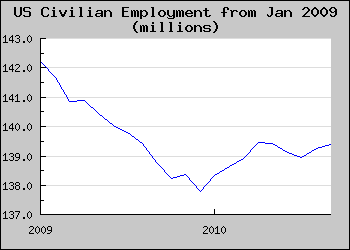
Yes, I know that everyone is howling about the miserable employment report this morning. But I'm here to say it ain't so bad. Looking at the Household Survey we get this:

It show employment on a reasonable uptrend. Nothing fancy, mind you, but it is something. But now look at this:

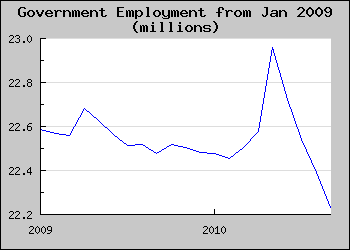
It shows government employment on a solid decline. (The big blip is the Census temporary employment.)

But we are clearly seeing government shedding employees. OK, it is very modest. Still, it amounts to 400,000 employees laid off from government in the last two years.

And that is good, because it is releasing people from wasteful government employment.

Even in the short run, it is a plus for the economy because, on unemployment, people are cheaper than when they are working for the government. But better than that, it makes them available for gainful employment in the private sector.

From a broader perspective, I would guess that each extra government employee is a net drag on the economy because, even though they are good people, they are doing harmful things, whether it is educating children badly or breaking up low-income families with welfare or hindering private sector growth with harmful economic regulation, or screwing up the health care industry.

So when you reduce government employment you are releasing downwards pressure on the economy and helping it to grow.

As New Gingrich says, we have a choice this November. We can vote for a food-stamp economy, or we can vote for a paycheck economy. It's that simple.

Thursday, October 7, 2010

Government is Force, Politics is Power

The world is full of people that talk about the sweet and gentle things that government does. It helps the poor; it gives grandma her health care; it cares about kids.

Er, not exactly. When the government does something it does it with your money. It is you that helps the poor, gives to grandma, and cares about kids. Government is not about caring; government is force. Let's expand this notion a little further.

Government is Force. What is a government, reduced to its essentials? It is an armed force that occupies an area of land with the power to extract tribute from the people living there. It might be a band of twenty guerrillas, hiding out in the mountains. But unless it gets money from a foreign power, it will survive by extracting tribute from the people it controls--by force. If it doesn't extract tribute by force, it isn't a government, it's a business.

Politics is Power. People that go into politics are people who like to fight. They want power. They run for election and the make promises to the voters about a glorious future they have in mind for the voters. But the promises are by-play. The name of the game is to get the support of the voters and get your hands on the levers of power.

Government Spending is Handing Out Plunder. Government spending is the loot that a government distributes to its supporters. Reduced to the minimum, the guerrilla group in the mountains, government spending is spending to keep the guerrilla group armed and fed and keep the taxes coming in. But as a guerrilla group becomes a formal government it acquires the power to support not just its armed fighters but its civilian supporters. So just as a victorious armed raid on a neighboring land ends with a division of the plunder, so also does a victorious political party distribute the loot among its supporters. But wait, you say! What about all the wonderful things that government does with health care and education?

The fact is that everything government does, it does badly. Social Security? If we have to force people to save for retirement we would do better forcing everyone to have an account at Fidelity or Vanguard. The money would actually go into creating jobs for young people when we want to stop working. Health care? The current system gives a ton of people free health care by forcing other people to pay for it. People use free stuff freely. If people actually paid for their health care (and saved for the big expense of health care in the last six months of life) it would cost a lot less. Education? Half of the kids entering college need remedial courses. What about the kids that don't go to college? Let's not even think of going there. Welfare? Government welfare has destroyed the low-income family.

To repeat: government buys votes by distributing plunder to its supporters. In the old days of the absolute monarchs government used to buy support with sinecures and pensions. Today it buys support with tenured jobs and social spending. So nothing has changed.

Taxes are Tribute. Taxes are the tribute that the laborer pays government for the right to earn a living. The first thing that our guerrilla group in the mountains does is start collecting tribute to keep its armed group fed and armed. It collects taxes by going around from house to house requisitioning food and money at the point of a gun. In a settled society, government exacts tribute from everyone that works or buys and sells. Thus every time that a worker gets a paycheck, the government takes its share. Every time a merchant sells a product, the government gets a share. Every homeowner pays a tax on his property. It is tribute, the tribute that the servant pays to the master.

Debt Ends in Default. Whenever government issues debt it is spending now and taxing later. Chances are that it won't do the hard thing, and fund the debt with taxes. Instead it will default on the debt. Sooner or later all governments default on their debt. Usually they don't flat out refuse to pay interest and principal. Instead they inflate the currency. Or they "reschedule" the debt by unilaterally lowering the interest rate and moving the maturity to a later date. Or they throw the evil bankers in jail. Or they just take money out of peoples' bank accounts. Remember, government is force.

The great question about any proposal for a new government spending program is simple. Is this really something that has to be done by force? After all, if it were worth doing, someone would already be doing it. Without force.

Wednesday, October 6, 2010

The Gift of Obama

Here is what I wrote about Obama in the moment of his election two years ago.

This is not a moment of hope and change, or a moment that will transform the world. This is just the prelude to new disasters as more and more government programs unreformed for twenty, fifty, or—in the case of public education—over a hundred years run off the road into the ditch.

The reason is simple.

You can’t deliver on hope and change when you have a vast government apparatus eating up 35 percent of gross domestic product and your program is to increase it.

Actually, I recall that my real reason for voting for President Obama was that I felt that we needed the Dems in charge of foreign policy. They'd spent the last eight years barracking (!) President Bush about his stupidity and his cowboy attitude and his lies and his failed war in Iraq. Now they needed to take the controls and actually get in contact with reality. What did they really want to do about radical Islam? The American people and the world needed to know.

Well, now we do know. President Obama has presided over the worst two years in American government since President Carter 32 years ago. His foreign policy is a disaster and his domestic policy is a disaster. His party is going to suffer the worst mid-term defeat in our living memory.

But there is no gratitude in politics. If you want a friend in Washington, said Harry Truman, get a dog. So here we have Michael Barone reporting on Democrats turning on President Obama, the chap that gave them pretty well everything he could, given the limitations of practical politics, and then some.

The nasty truth is that the Democrats of the 2000s wanted to see a total humiliation of Bush's America.

They hoped to see an abject and abrupt withdrawal of U.S. troops from Iraq within weeks of the Obama inauguration. They hoped to see a beginning of withdrawal from Afghanistan not in July 2011 but in the early months of 2009. They hoped to see the detention facility at Guantanamo closed and shuttered and the detainees tried in civilian courts or freed to regale the media with tales of torture.

But of course, President Obama can't give them that. His job is to defend the United States and promote its power interests. So he has disappointed the Angry Left at every turn.

This was why I voted for Obama. To force the Democratic ruling elite to confront reality. So far, so good.

I realize now that I expected the Angry Left to become sadder and wiser as Obama tried and failed to give them what they want. Instead they are surly and angry, and they want to take it out on Obama.

Without saying so, Obama has found himself having to teach this lesson to the Adam Serwers of the world. They don't like hearing it. They're keeping their ears plugged up and their eyes defiantly shut. Their MyObama Web pages are inactive and their checkbooks are closed. They've tuned out of the campaign and many of them won't even vote. The president they helped elect -- and the world -- have turned out not to be what they thought.

These folks are delusional. They are too stupid to see that Obama has tried to give them everything they wanted, but the fact is that he can't. If they cannot see that then they need a long spell in the political wilderness. So Job #1 of the Obama Years is complete.

But now we face the bigger question left undone by the Bush years. It is the job of setting a new direction for America in domestic politics. And that means, sooner or later, abandoning the government-centric entitlement state and re-socializing America.

You can call it what you like: a free society, spontaneous sociability, a culture of trust. It all comes down to the same thing. Government is force; politics is power. Society is something bigger, something deeper than mere government.

We are talking about the wail of Scarlett O'Hara: Where shall I go? What shall I do? It's the eternal human questioning after the meaning of life. It grows out of the very nature of humans as social animals seeking meaning in a world whose meaning is a mystery.

And now that liberalism has imploded, it's up to us: conservatives, moderates, recovering liberals. We are America, and this is our moment. Let us work to make sure that we deserve the heavy responsibilities that will be shortly ours.

Tuesday, October 5, 2010

The Democrats' Ethnic Split

Never mind that Democrats are splitting between their left-wing progressive elitists and their more moderate wing. There's also trouble on the ethnic front, as the fighting Irishman, Pat Buchanan, observes. Sure, the Democrats are going to benefit from the minoritization of whites as non-whites become a larger and larger proportion of the electorate.

Yet, within the Barack Obama coalition -- over 60 percent of Asian-Americans, 68 percent of Hispanics, 78 percent of Jews, 95 percent of blacks -- fissures and fractures have become visible, not only along racial and ethnic lines, but along issue and ideological lines.

Asian Americans are fracturing over Affirmative Action; Jews are fracturing over support for Israel; blacks and Hispanics are dividing over patronage and turf.

Actually, I think that too much can be made of this. The key factor in splitting people off from the Democratic Party is the hyphen. When people stop thinking of themselves as hyphenated Americans, but just Americans, that's when they are ready to become Republicans.

I'm going to go out on a limb here and say that this effect is starting in the black community. We've seen blacks calling themselves "Americans" at Tea Party rallies. We are also seeing black candidates running for Congress as Republicans. There's Allen West, who's a retired army colonel running in Florida's 22nd District. And today's poster boy is Ryan Frazier, running for Colorado's 7th District. According to his campaign site:

Ryan Frazier is a husband and father of three, a military veteran, a small businessman, an elected representative, and a co-founder of a pre-K through 8th grade public charter school.

They don't get more Republican than that.

The biggest reason that keeps ethnics in the Democratic Party is the feeling of being an embattled minority. When you feel like that you belong in the Democratic Party, because the Democrats provide an institutional framework for people that feel threatened by the larger society.

Sooner or later, the members of ethnic groups discover, one by one, that it's safe to go into the water. That's when they leave the Democratic Party.

Meanwhile, it can't hurt, as Pat Buchanan point out, that the coming age of austerity makes it difficult for Democratic bosses to share out an expanding pie among their hungry clients.

When the pie is expanding, everyone can have a larger slice. The crisis of the Party of Government, however, is that we have entered an era where most Americans distrust government and many detest government. Second, with the national debt surging to 100 percent of gross domestic product and a third consecutive deficit running at 10 percent of GDP, we are entering a time of austerity, a time of shared sacrifice.

How will a period of austerity play out? Let's face it: nobody knows.

Monday, October 4, 2010

Watching the Democrats Split

One of the disadvantages of the MSM is that they are always looking for the Republicans to split, but never notice the Democrats splitting until the chasm is right in front of them.

Thus it is left to The New York Times crypto-conservative Ross Douthat to point out that, usually, the Democrats are split into a left wing and a moderate wing.

On one side was the liberal left — populist in economics and dovish on foreign policy, in favor of lavish spending programs and suspicious of big business, and hostile to any idea that seemed to give an inch to the conservatives.

On the other were the moderates and centrists — pro-market and pro-Wall Street, inclined to tiptoe rightward on issues like crime and welfare, and hawkish about deficits and dictators alike.

In the special conditions of 2005-2008 these two factions were able to come together, mostly because they hated President Bush.

Unfortunately, President Obama has not kept the two sides together. Indeed,

Obama has managed the more difficult feat of alienating both of them at once.

The party’s centrists, from Blue Dog Democrats to Wall Street, insist that he’s turned out to be far more liberal than they expected. The health care bill was too expensive. The deficits are too big. He’s been too hard on business interests, and on Israel. And what happened to bipartisanship?

On the left, meanwhile, Obama is deemed a disappointment for all the things he hasn’t done. The stimulus should have been bigger. The financial reforms should have been tougher. He should have withdrawn from Afghanistan. He should have taken the fight to the Republicans, instead of letting them obstruct.

This leaves President Obama with a single way out of his political problem. He must "unite his party around their common fears." That is French for tearing the country apart.

You don't get your average MSMer figuring that out.

This has to mean that the current polls underestimate the defeat that the Democrats will suffer in November. The Weekly Standard's Jay Cost looks at the polls--in what we might call a "technical analysis"--and determines that whatever way you look at the numbers, the Democrats are in trouble.

But his analysis uses turnout models that don't differ very much from most recent elections. The fact is, he admits, that the closest turnout model is Virginia in 2009. It produces a ten point lead for Republicans.

The only people who can recall a result so pro-Republican are nonagenarians, as nothing like this has happened since 1928. How many seats this would produce is very hard to say, but I’ll put it this way: Republicans picked up 52 seats in 1994 with a +6.7 win; a +10 win should produce more than 52 seats, perhaps many more.

And Jay Cost is not trying to impress any "fundamental analysis" on his results. What does it mean to turnout if the Democratic Party is split and discouraged and Democrats continue sitting around and blaming each other as they have started to do?

The only thing to do is quote Ronald Reagan: "You ain't seen nothing yet." I'm still holding out for an 80 seat Republican pickup in the House.

Friday, October 1, 2010

The Three Liberal Conceits

It feels like 9/11, watching the twin towers burning, thinking about "one hour buildings" and wondering what comes next.

I'm talking, of course, about the mid-term elections on November 2. We are looking at the Democratic Party as it trails a black cloud of smoke and we are wondering: could the whole thing come down in a great crash? And if it did come down would it be in that dreadful slow motion descent of the twin towers, or the sub-second dump of the I-35W bridge in Minneapolis? One moment it was there, the next moment it was in the river.

Everything is collapsing on the liberals all at once. Their multidecadal war on the private sector, where they want to boss banks and corporations around to help workers get good jobs or to help minorities buy a home, is in ruins, as their confident Keynesian stimulus has failed. Their war on want is a mess as the administrative manipulations of a thousand social programs make dependents out of proud workers. Their war on tradition is a mess as the sexual revolution turns into a re-commodification of sex.

There are, I think, Three Conceits at the heart of this liberal meltdown. Let's take them one by one.

First, there is the Economic Conceit, the idea that government can run the economy. There certainly is a need for the government to commandeer the economy in case of all-out war. But the record of the last century is that, absent war, government should keep its cotton-picking hands off. Government shouldn't muck around with monetary policy and the credit system. All it does is institutionalize inflation and play favorites with the credit system. Government shouldn't muck about with corporations vs. labor vs. the consumer. The wreck of the auto companies ought to tell us that. As George McGovern found out when he opened a resort hotel and then went bankrupt, business is incredibly difficult. Politicians shouldn't make it harder.

Secondly, there is the Social Conceit, the idea that government can spread the wealth and alleviate poverty, that government can run the education system and supervise the health care system. No it can't. The education system is dead in the water, and has been for a generation. The reason? It's been captured by the producers who don't give a damn about the consumers, children and parents. The Obamis are in the middle of bollixing up the health care system by leaning on it to serve an additional 30 million people who are reluctant to pay for their own health care. Government just can't do this efficiently and effectively.

Thirdly, there is the Moral Conceit, the idea that government can muck around legislating morality. Oh yes, liberals believe in legislating morality all right. That's what all the fuss about abortion and gay marriage is about. Liberals decided to change, by judicial fiat, the moral rules on babies and marriage. Now everyone wants to use the government to force their moral views on the rest of the nation.

What is going on here? What do liberals not understand?

I think that we need to look at society in a new way. Think of a circle, divided into three sectors. One is the political sector, with the institutions of government at all levels. This is the sector of force. Then there is the economic sector, of businesses and consumers, producing and consuming products and services. This is the sector of stuff. Then there is the moral/cultural sector, with various non-economic institutions, churches, schools, charities, foundations, and voluntary associations. The point about these insitutions is that they are not immediately economic. They have moral or social goals, not economic goals. This is the sector of faith.

The big mistake that liberals have made, as reflected in the Three Conceits, is that the political sector can supervise and co-opt the other two sectors. It can't. The political sector is the sector of force, and force is the only thing it knows. When you do force in the economic sector you get serfdom. When you do force in the moral/cultural sector you get a clash of faith, a religious war, and even a religious civil war. The three sectors need to be separate and equal in a Greater Separation of Powers. None should dominate another sector, and no two should gang up on the third.

This is all very well, but there is something missing. It is people. It one thing to understand the relationships of the institutions in society, it is another thing to figure out the people.

The people, I believe, are a circle in the middle. Call it the personal sector. The personal sector is the face-to-face sector, where people deal with each other verbally. It is the sector of trust.

The whole universe of society is a question of trust, but trust is only possible between face-to-face people. Without people in the middle you have nothing but force, the mechanical interactions between inanimate objects rather than the relationships of trust between people.

So when we say that the three sectors should be separate and coequal, and kept so by a Greater Separation of Powers, we understand also that this social compact is made possible by the folks in the middle, in the personal sector. These people in the middle act in face to face relationship with other people and it is the trust that they develop over time that creates the delicate balance between the sectors.

It is people representing institutions in the economic sector that link with people representing institutions in the moral/cultural sector that put material content into moral concern. It is people representing institutions in the moral/cultural sector linking with people representing institutions in the political sector that define the boundary where moral disapproval turns into legal restraint. It is people representing institutions in the economic sector linking with people representing institutions in the political and moral/cultural sectors that define the boundaries where a bad deal turns into a fraudulent deal.

Our liberal friends are good people. But they were tempted by vanity, and vanity turned into conceit. And now conceit is turning into humiliation.

After November 2, let's cut the political sector down to size and reanimate the spirit of trust that turns adversaries into friends.

Then we can build an America as it was meant to be.