Wednesday, September 8, 2010

I, Economy vs. I, Government

We are having, this fall, a national conversation. It is one that liberals would rather we didn't. That's because, as Attorney General Eric Holder might say, we are cowards.

The conversation is about the limits of government. What should government do, and what shouldn't it do?

Conservatives say that government should be limited. It should do defense and policing and law, and very little else. When it gets beyond the area of force, the defense against enemies foreign and domestic, it makes a mess. That's because government turns everything it touches into a contest of power. It always gets to be a fight to see who gets to wield the power of the state.

Jonah Goldberg has a column today, "I, Market Economy," that tells why government makes such a mess with everything it does. Why? Because everything that we make in the world is unbelievably complex. Take the pencil.

“I am a lead pencil — the ordinary wooden pencil familiar to all boys and girls and adults who can read and write.” It is one of the most simple objects in human civilization. And yet, “not a single person on the face of this earth knows how to make me.”

Even a product as simple as a lead pencil is a product of a vast collaboration of producers and experts and middlemen and consumers and prices advertised and prices paid.

The lessons one can draw from this fact are humbling. For starters, any healthy civilization, never mind any healthy economy, involves unfathomably vast amounts of harmonious cooperation.

But government isn't harmonious cooperation. Government is force.

Government says: this is the way we are going to do education, so fall into line. But Mr. President! Over here! We've got an idea we would like to try out! Forget it, pal. Come back in ten years when you've got a political movement, and you can move the needle on my next election.

With I, Government, there is only one way, and that way is the way of the most political powerful coalition. With I, Economy, there are a million ways. Mostly, of course, the market economy follows the big bucks. Millions of people want Wal-Mart's Always Low Prices. But some people want quirky old-fashioned bow ties. And they get them--off the internet. Millions of people want fast food good and cheap. They get it, at McDonalds. But some people want fresh food grown locally. They get it--in some liberal enclave at an organic food cooperative.

In I, Government, the ruling coalition gets its way, and that's it until the revolution. In I, Economy, the majority gets its way. But so does the minority. And there is always room for a nobody to find a niche that nobody ever thought of. It always looks like the big boys run the show. But below the radar the next Bill Gates or Steve Jobs is working away to change the world.

I, Government likes to wield power. But its power is always the power of the gun and the billy club. All it can do is bruise and intimidate. That's why government always mucks up the economy. All taxes and all credit manipulations hurt the economy. But if you keep tax rates down, and money sound, the damage that government's billy club does is minimized.

President Obama wants to raise income taxes on the rich, from about 35 percent on marginal income to about 40 percent. And he wants to raise the FICA tax too.

You can talk all you like, Mr. President, about sharing the wealth, and that at some point you don't need any more money. But when you are taxing at 25, 30, 35, 40 percent of marginal income you are laying about you with a billy club and you are bruising the harmonious cooperation of the market economy.

Progressives, Goldberg concludes, like to say that "we're all in it together." Another progressive line is the idea of shared sacrifice. These communitarian notions are best applied in a crisis when people willing stop what they are doing to devote themselves completely to helping their neighbors in distress.

But what progressives fail to see is that the market economy is a day-to-day realization of "we're all in it together." We are all out there trying to make a living and learning every day that earning a living means giving other people what they want. We must each of us sacrifice our druthers--our dreams and fantasies--in order to serve other people and thereby earn a living.

Some day, humans will discover a method of social cooperation far better than the market economy. But here's a nickel that says that it won't be a government scheme to "share the wealth."

Tuesday, September 7, 2010

Democrats Betray Creative Class

Ever since the emergence of the Christian Right in the 1970s Democrats have been able to stigmatize socially-conservative Americans as narrow-minded and bigoted. This has helped them to a large share of the "creative class," Americans who don't think much about social and moral issues, but sense that traditional values crimp their freedom to live a life of

wholehearted dedication to a freely chosen course or cause, and not to any truth anchored in a collectivity or a world beyond the individual[.]

That quote is from Existentialism vs. Marxism by George Novak. So we should recognize that creative Americans are existentialists of a kind.

For years Democrats managed to create a divide between "creative" Americans and "traditional" Americans. If you were young and educated you probably didn't want to be counted as a traditional American.

Just to be on the safe side, liberal professors and administrators made colleges into sexual free-fire zones, always a winner with the young set.

Creative Americans come in different shapes and sizes, but obviously there is a divide between the economically creative, i.e. business owners, and the culturally creative, i.e., artists, writers, academicians. Democrats have owned the culturally creative for decades, but in recent years they have managed to detach the business class from their natural home in the economically conservative and now unfashionably cultural conservative Republican Party.

In the 2000s the young generation of entrepreneurs clearly got persuaded that they didn't need the embarrassing Republican Party. The Clintonesque New Democrats understood business and had moved away from knee-jerk liberalism. And after the Reagan and Bush tax rate cuts, who needed the Republicans?

People like Richard Florida started writing books about the creative class that lived and worked in "ideopolises." John B. Judis and Ruy Teixeira wrote a book about The Emerging Democratic Majority that would center on minorities, young people, and the creative class.

This strategy worked like a champ while people believed that the Democrats were economically centrist and socially liberal. But people don't believe that any more.

The economic meltdown and the proposed huge expansion of big government has been a wakeup call for the economic creative class. Now all of a sudden economic issues matter to them. And the embarrassment of the Christian Right doesn't seem quite so important.

This is the great achievement of President Obama. He has thrown away the economic creative class. If he had governed from the center, done Clintonesque New Democrat things to the economy, and put off the nationalization of health care till the economy had improved, then he would have had the creative class for a generation.

But now he has thrown it all away.

Of course, the reality is that the Democrats were never really "New Democrats." They were faking it back in the 1990s because that was the only way they could get elected.

Then they got back into power in 2006 on the back of the second term mid-term election syndrome. They could talk about an unpopular war and corruption and family values and get elected to a majority in Congress.

After 2008 with a Democratic president and big majorities in Congress they decided that they should go for the big one: health care. Big controversial entitlements never get repealed. After all, in 1936 they got Social Security. In 1965 they got Medicare. This time they would do ObamaCare and in ten years everyone would love them.

When generals do that sort of thing they are accused of trying to fight the last war.

We conservatives should thank our lucky stars for Obama. He has sent a whole generation of Americans back into the Republican tent. He's made them see that tax policy and spending policy and credit policy really matter. He's probably inoculated them for a generation. In fact there's a possibility that we may even be able to do something about entitlement reform in the aftermath of Obama.

There's a good chance that we are looking at a generation of Republican majorities.

Everything will be practical and sensible until a new generation arises that knew not Obama.

But that's in the long run, and in the long run we are all dead. As the childless John Maynard Keynes said.

Monday, September 6, 2010

A year late Mr President

Talk about a day late and a dollar short. Only now, two years after the political class knew that the recession was a big one, is the president coming up with business tax cuts. At least that is what is being predicted for the president's speech on Wednesday.

Apparently the president will propose $100 billion in business tax cuts including an R&D tax credit and $35 billion in small business tax cuts.

Frankly, Mr. President, the fact that you are coming up with this crowd-pleasing package now, within 60 days of an election, an election in which your party is expected to get clobbered, is a very good reason to vote against you.

You are telling us that only when you have been hit over the head with a 2 by 4 are you willing to propose a sensible, practical economic policy.

Look, I understand that politics is power. I understand that politicians don't give a damn about the economy except to the extent that it can deliver revenues to the government.

But the American people have a right to expect that, when they elect a president, he would be sensitive to the needs of the economy. We don't expect the president to be way out ahead of public opinion, but we do expect him to be right there in the center of conventional wisdom.

We believe it is outrageous when the president is just about the last person in America to realize that the way you stimulate the economy is with changes to the marginal costs that businesses must pay, i.e., taxes and government mandates.

And conventional wisdom has held for a while now that straight Keynesianism is not an appropriate response to a downturn in the economy. Why? Because Keynesian economics does not really comprehend that all business decisions are taken at the margin. It just sprays out money to political favored constituencies and hopes that everything will return to normal when the government runs out of spray money.

There's an old story, Mr. President, about killing the goose that lays the golden eggs. When we talk about the economy that means thinking about how government decisions affect businesses. If you raise income tax rates on high-income business owners, then the chances are that the business owners will have less money to expand their businesses. If you have high tax rates on corporate income then chances are that corporations will get over-leveraged and find themselves badly burned by an economic downturn.

Only now, Mr. President, after your economic policies have failed to restart the economy, only now with electoral disaster staring you in the face, are you proposing economic policies that are semi-oriented towards helping economic recovery.

I'd say, Mr. President, that when an administration bungles economic policy has badly as yours has done, that there is only one thing for the voters to do: throw the bums out.

But then, that's why I voted for you back in 2008. I figured that nothing would cure the voters of Democratic government faster than Democratic government.

As usual, I was wrong. I had no clue, no clue how fast the American voters would reject the people and the policies of the Democratic ruling class.

Now, about those entitlements, Mr. President.

Friday, September 3, 2010

Our Friendship vs. Their Resentment

After the success of the Glenn Beck Restoring Honor rally, some of our liberal friends are determined not to be outdone. Labor and religious leaders and the NAACP are organizing a rally on the National Mall for October 2.

"The AFL-CIO is determined that the Tea Party and its corporate backers are not going to get the final word,” said AFL-CIO executive vice president Arlene Holt Baker. "We will expect tens of thousands of union families to come." "We are fueled by hope and not hate," Holt Baker said.

I have a suggestion for the labor and religious leaders and the NAACP. Don't.

If you chaps mount a rally it will show up a profound difference between the goal and the vision of the Beck folks and the goals and vision of you lefty chaps.

The difference that will come out for all to see is the difference between friendship, not to mention faith, hope and charity, and the resentment that powers the left.

The mainstream of western thought owes much to the commonplace assertion of Aristotle, that we are social animals. The notion of human sociability suggests the idea that we should resolve our differences in a spirit of friendly negotiation rather than by force.

That was the point of the Restoring Honor rally. It was a friendly gathering. In fact the folks that attended spent a lot of the time friending each other on Facebook. A young black woman at the rally told the media not to call her an African American, but an American. "These are my family," she asserted, echoing the words of an older black man who testified to the media back in the spring.

The speakers at the Beck rally also emphasized the Christian values of faith, hope, and charity, not to mention the notion of the providential God that is shared by both Christians and Jews.

They did not mention specific goodies they wanted in recompense for past injustice.

Living under a providential God, or blessed to live in the culture of American exceptionalism, we Americans discover a responsibility to deserve the providential love of God. So the rally speakers emphasized that the future begins with us, with our dedication to responsibility, friendship, kindness.

But the left believes in a culture of resentment, a resentment nurtured in the minds of helpless victims cheated of their rightful place in the world by oppressors and exploiters.

There is, of course, plenty of injustice in the world, and resentment is a natural sentiment that all of us experience. We resent the friend that got into Harvard when we didn't, the co-worker that gets a promotion that we didn't, the guy that got the girl that we didn't. Resentment shows up in the seven deadly sins as envy, only resentment is envy on steroids.

You want to watch that envy, because, according to Roger Scruton in A Political Philosophy resentment is the emotion that leads to totalitarianism.

I see [resentment] as an emotion that arises in all societies, being a natural offshoot of the competition for advantage. Totalitarian ideologies are adopted because they rationalize resentment, and also unite the resentful around a common cause. Totalitarian systems arise when the resentful, having seized power, proceed to abolish the institutions that have conferred power on others, institutions like law, property and religion which create hierarchies, authorities and privileges, and which enable individuals to assert sovereignty over their own lives.

Once the resentful acquire power they reduce everything to pure power, and "dispense with mediating institutions"; individual rights are replaced by central control. We have seen how this works. Central control everywhere seems to mean bureaucracy.

Converted into a "centralized power structure" society becomes transformed into an army. An army is, after all, a centralized power structure for projecting power on neighboring territories.

But in the totalitarian power structure the power is directed inside the territory, at groups targeted for punishment. These targeted groups become the replacement for the ancient scapegoat in which tribal societies purged themselves of the wrath of the gods.

The Jacobins targeted the aristocrats and then "emigrés." The Soviets targeted the bourgeoisie and then "kulaks." The Nazis targeted the Jews. Sen. Joseph McCarthy (R-WI) targeted Communists.

Our liberal friends, unfortunately, have too often toyed with this inflammatory material. They used to target the malefactors of great wealth. Then it was the big corporations. Then it was the racist South. It used to be the religious right, but now it is the Tea Party activists, who are stigmatized and marginalized as racists, bigots, sexists, and homophobes.

It is, of course, laughable to turn the Tea Party into the liberal scapegoat-du-jour. These chaps haven't done anything yet except go to rallies and pitch out a couple of Republican senators.

But there is a bigger issue in the resentment/scapegoat dynamic. In its original form, the scapegoat was the king. It had to be. It must be the king who must be sacrificed to propitiate the gods. That should be obvious. The king is the representative of the tribe or nation. If something has gone wrong, then he should take the blame. To sacrifice a lesser person is an insult to the gods, and would provoke the gods to greater wrath.

The scapegoat concept is understood in the corporate and military shibboleth that, when things go well you say that your team were the ones that made it possible. When things go wrong, then you, the leader, take the blame.

President Bush understood this. He understood that he had to be the national scapegoat for the unpopular war against terror. He bowed his head and took it like a man--like a mensch, you might say.

But liberals don't understand this. That is why they are going ahead with their October 2 rally, which will doubtless be a display of liberal resentment. Of course, Jim Wallis, liberal evangelical, insists that it will all be sweetness and light. "[W]e must move this country forward beyond divisiveness and hate, to rebuild and reclaim our destiny," he says.

But then why does organizer Holt Baker talk about the "Tea Party and its corporate backers?" Corporate backers? He means, one assumes, the libertarian billionaire Koch brothers and the Scaife family that fund groups like Americans for Prosperity and FreedomWorks.

My advice to liberals is to put money into keeping as many of your senators and representatives in the game as possible. make sure that your troops are properly led and execute on a good strategic retreat.

But don't try to pretend that you can turn out a grass-roots movement this fall that can rival the Tea Party.

Because if you showcase your political philosophy of resentment up against the Beck philosophy of Restoring Honor you guys are going to look like the sore losers.

The Jobless Recovery

So here we are at Labor Day and there's been an uptick in employment. Which is good.

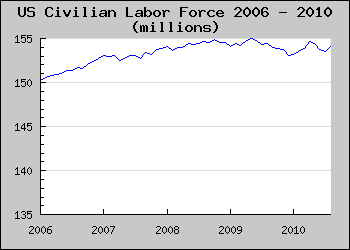
Yes, I know that the unemployment rate ticked upwards from 9.5 to 9.6 percent, but that's normal in the early part of a recovery as people who have given up looking for work return to the labor force. You have to be "looking" to be counted in the labor force.

Actual employment went up.

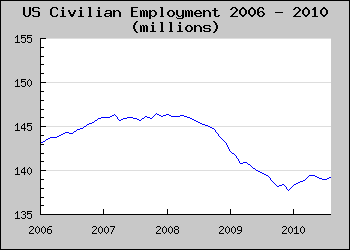
According to the Labor Department Household Survey civilian employment went up from 138.96 million 139.25 million. That's a tad under 300,000.

But these charts tell you the real problem. Here's the civilian labor force since 2006.

And here's the civilian employment.

I reckon that's what you call a jobless recovery. Of course Democrats were all over President Bush back in the mid 2000s when unemployment was 6 percent. So I suppose turnabout is fair play.

But the charts do show what a dog's breakfast President Obama has made over economic policy. We don't need ObamaCare. We don't need stimulus programs to save the jobs of teachers. We don't need higher energy prices. We need lower taxes on business so that business owners can have the confidence to grow and hire more workers. We need to get that number of the employed from just under 140 million and crank it up to 145 million. Pronto.

Any ideas, Mr. President?

Thursday, September 2, 2010

Next Year's Agenda

Some people are getting impatient. They are asking why the Republican Party doesn't have a party position for the mid-terms. Other people are looking forward already to a Republican Congress. They are asking how the Republicans should avoid the mistakes of 1995.

I think the critical thing is to tell the truth and shame the devil. That's Shakespeare, by the way.

For the Fall election it is critical for Republicans to promise what they really intend to do come January. It's not hard to come up with a doable agenda: continue the Bush tax rates and lower corporate income tax rates; repeal ObamaCare and start over on a non-bureaucratic approach to health care; cut wasteful spending.

The American people are not yet ready to cut entitlements. They need to see the entitlements system broken before they will agree to that. But there's plenty of other stuff to work on. There is the utter waste of government money in education, for starters. Then there is green energy, that is crony capitalism from start to finish. Then there is the fabulous ethanol program. There are tons of things that can be cut at the margin as governors like Mitch Daniels and Chris Christie have shown.

After the elections, whatever the result, President Obama will have to start working with Republicans. No more "I won," or telling people to shut up while he fixes things that Bush broke. Republicans should start working with the president, or at least urgently saying to the media that they need to get together with the president and solve the nation's problems.

The people have spoken, Republicans should say. But the president is still the president, and we are all Americans. We should work together. What the people have told us is that they don't like bailouts, they don't like stimulus, they don't like ObamaCare, and they don't like earmarks. So let's get together, Mr. President, let's clean up the nation's capital as you promised in 2008 and get about the people's business.

Personally, I feel that President Obama is no Bill Clinton, and that he just doesn't have the talent or the temperament or the experience to do a good job negotiating on the issue-by-issue process of day-to-day government. I think he's a guy that likes to say: call me in when it's time to call the big shots.

But the Republicans must treat the president as the president. If he won't deal straight--and I don't think he will--then they need to go to the media and the talk-show hosts and tell them about it.

But Republicans must start out in September with a clear and honest agenda, and then continue in January saying: let's get together Mr. President and let's work together for the American people.

Wednesday, September 1, 2010

2010 Isn't 1994, etc.

People in the political world like to sneer at generals for "fighting the last war." So what is all the talk of 1994, and the worrying about a Republican Congress overreaching in 2011 in a reprise of 1995?

As Ronald Reagan said: to say that Congress spends money like a drunken sailor is an insult to drunken sailors. And the re-fighting the wars of 1994 and 1995 is an insult to generals.

The only thing we know is that 2010 won't be a replay of 1994 and that 2011 won't be a replay of 1995. However, like any general that has studied recent wars, it certainly doesn't hurt for us to recall the lessons of 1994 and 1995.

First of all, 1995 may have been a tactical defeat for Republicans in that President Clinton "won" the government shutdown. But in the medium term Republicans actually did reduce the rate of increase in spending. The problem for Republicans was not 1995, it was 1998. That was the year when the budget went into surplus and President Clinton started saying telling Americans that, yes he could cut taxes and return money to the taxpayers but then maybe the taxpayers would waste it. That was voters started to think that we could relax the purse strings a little.

That sentiment gave us the 2000s and a Republican Congress that gorged itself on earmarks.

Anyway, all the talk about debt and deficits and bailouts rather misses the point. The whole key to the federal spending problem is, #1 Medicare, #2 Medicaid, and #3 Social Security. That's where the money is.

The Medicare problem is simple. Affluent middle-class seniors (like me) will have to pay full freight on health care. It is simply unjust for people with money (i.e., older people with savings) to tax the hides out of 30 somethings much less wealthy than they are. The fact is that most middle-class seniors can afford to pay for our own health care. And we should.

Of course, that might mean that a lot of seniors won't be able to afford to become snowbirds and winter down south.

When we affluent seniors start to pay full-freight on our health care we will start to find ways to economize on health care. We will revolutionize health care and all of a sudden health care costs will stop their exponential rise into the stratosphere.

Once the Medicare problem is solved, then Medicaid will follow. Don't know how, but it will. The American people will demand it.

Social Security? You can fix Social Security with a financial coup de main. For instance, you can capitalize current benefits by awarding Social Security beneficiaries special Treasury bonds that pay off Social Security benefits and then privatize the whole thing. Again, it's a matter of justice. People in their fifites and sixties should save, big time, for their retirement. And guess what: our savings will go to create the jobs for the 30 somethings. As is should be.

When will middle-class seniors be ready to pay full freight on health care? When Medicare is completely broken. And that won't be in 2011.

So Republicans won't be doing a grand reform on entitlements in 2011. But Republicans can start the ball rolling by offering, e.g., a New Medicare that offers a fixed subsidy that you can apply to your own health insurance plan.

One thing is for sure. We are living in interesting times.